Decoding the 2026 Bond Market: Opportunities in a 10-Year Treasury Yield Environment
Anúncios
Decoding the 2026 Bond Market: Opportunities in a 10-Year Treasury Yield Environment
The financial landscape is in a constant state of flux, and for investors, understanding the future trajectory of key market indicators is paramount. As we look towards the 2026 bond market, particular attention is being paid to the dynamic environment surrounding 10-year Treasury yields. This period is anticipated to be shaped by a confluence of economic factors, including inflation trends, central bank monetary policy, geopolitical developments, and technological advancements. Navigating this intricate web requires a nuanced understanding of these forces and their potential impact on fixed-income investments. This comprehensive guide will delve into the anticipated conditions of the 2026 bond market, offering insights into potential opportunities and challenges for investors.
For many, the bond market represents a cornerstone of a diversified investment portfolio, offering stability and income generation. However, the returns and risks associated with bonds are heavily influenced by the prevailing interest rate environment, with the 10-year Treasury yield often serving as a benchmark. Predicting its movement requires a deep dive into macroeconomic forecasts and an appreciation for the unpredictable nature of global events. Our exploration will cover the key drivers of bond yields, analyze various scenarios for the 2026 bond market, and provide actionable strategies for investors seeking to optimize their portfolios.
Anúncios
Understanding the Current Economic Climate and its Influence on the 2026 Bond Market
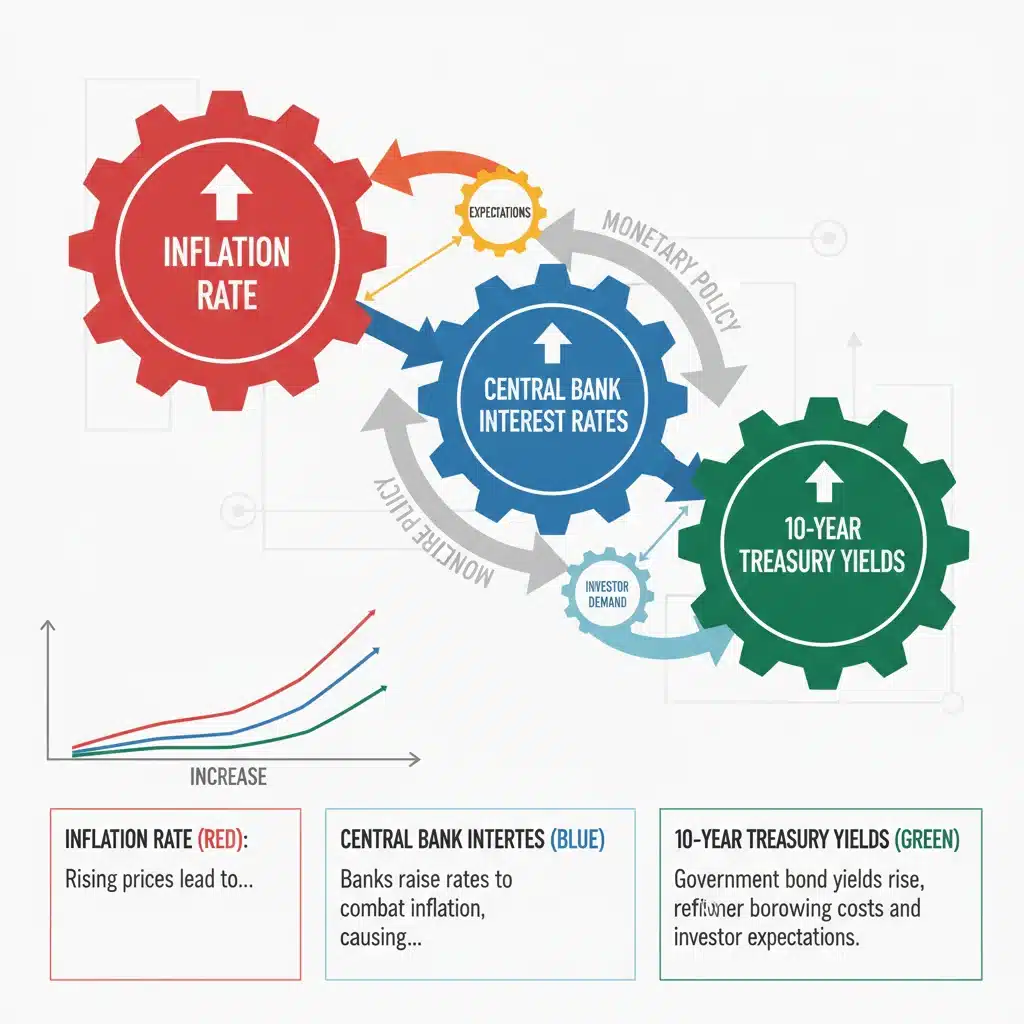
Before projecting into 2026, it’s crucial to understand the foundational economic conditions that will likely carry over or evolve. The global economy has been grappling with persistent inflation, supply chain disruptions, and the lingering effects of unprecedented monetary stimulus. Central banks worldwide have responded by tightening monetary policy, leading to a period of rising interest rates. This tightening cycle has significantly impacted bond valuations, causing yields to rise and bond prices to fall.
The interplay between inflation and interest rates is fundamental to the 2026 bond market outlook. If inflation remains stubbornly high, central banks may be compelled to maintain a restrictive stance, potentially keeping 10-year Treasury yields elevated. Conversely, if inflation moderates more rapidly than expected, there could be room for central banks to ease policy, which might lead to a decline in yields. However, the path of inflation is rarely linear, and various external factors, such as energy prices, geopolitical tensions, and wage growth, can introduce significant volatility.
Anúncios
Beyond inflation, economic growth projections play a vital role. A robust economy typically implies higher demand for credit and potentially higher interest rates, while a slowdown could lead to lower rates as policymakers seek to stimulate activity. Labor market strength, consumer spending patterns, and global trade dynamics will all contribute to the overall economic narrative that shapes the 2026 bond market.
Key Economic Indicators to Watch
- Inflation Data: Consumer Price Index (CPI) and Personal Consumption Expenditures (PCE) will be critical for gauging inflationary pressures.
- Interest Rate Decisions: Statements and actions from the Federal Reserve, European Central Bank, and other major central banks will directly influence bond yields.
- GDP Growth: Economic output figures will indicate the health and trajectory of the economy.
- Employment Reports: Unemployment rates, job creation, and wage growth provide insights into labor market strength and potential inflationary pressures.
- Geopolitical Developments: Conflicts, trade disputes, and political instability can introduce uncertainty and drive flight-to-safety demand for government bonds, impacting yields.
Forecasting 10-Year Treasury Yields in the 2026 Bond Market
The 10-year Treasury yield is a bellwether for the broader fixed-income market and a key determinant for many other interest rates, including mortgages and corporate bonds. Predicting its level in 2026 involves considering several potential scenarios, each with its own set of assumptions about economic growth, inflation, and monetary policy.
One scenario posits a ‘soft landing,’ where inflation gradually returns to target levels without a significant economic recession. In this environment, central banks might begin to normalize interest rates, leading to a moderate and stable yield curve. The 10-year Treasury yield might settle into a range that reflects sustainable economic growth and controlled inflation. This would likely be a favorable scenario for bond investors seeking predictable income.
Another possibility is a ‘hard landing’ or recessionary environment. If aggressive monetary tightening leads to a sharp economic contraction, demand for safe-haven assets like U.S. Treasuries could surge. This increased demand, coupled with potential interest rate cuts by central banks to stimulate the economy, could drive 10-year Treasury yields significantly lower. While this might offer capital appreciation for existing bondholders, it would also signal broader economic distress.
Conversely, a scenario of ‘sticky inflation’ could see inflation remaining elevated despite central bank efforts. In such a case, central banks might be forced to keep interest rates higher for longer, or even implement further hikes. This would likely push 10-year Treasury yields upwards, potentially leading to continued pressure on bond prices. This scenario presents a challenging environment for fixed-income investors, as real returns could be eroded by inflation.
Technological advancements, particularly in areas like artificial intelligence and automation, could also play a role. Increased productivity from these innovations could help to dampen inflationary pressures in the long run, potentially influencing the trajectory of bond yields. However, the immediate impact is often debated, with some arguing that initial investment in these technologies could lead to short-term inflationary pressures.
Monetary Policy’s Role in Shaping the 2026 Bond Market
Central banks, especially the Federal Reserve, wield immense influence over the bond market through their monetary policy decisions. Their actions on the federal funds rate, quantitative easing (QE), and quantitative tightening (QT) directly impact the supply and demand for bonds, thereby affecting yields. As we approach 2026, the cumulative effect of current and future policy decisions will be profoundly felt.
The Federal Reserve’s dual mandate of maximum employment and price stability guides its policy. If inflation is tamed by 2026, and the labor market remains robust, the Fed might adopt a more neutral stance, allowing for market forces to dictate bond yields more freely. However, if either of these mandates is under threat, the Fed will likely intervene, potentially causing significant shifts in the 2026 bond market.
Furthermore, the global nature of financial markets means that policies from other major central banks – such as the European Central Bank (ECB), the Bank of Japan (BOJ), and the Bank of England (BOE) – can also have spillover effects on U.S. Treasury yields. Divergent or convergent monetary policies among these institutions can influence capital flows and investor sentiment, creating additional layers of complexity for the 2026 bond market.
Potential Monetary Policy Trajectories
- Sustained Tightening: If inflation remains elevated, central banks might continue to raise rates or keep them high for an extended period, leading to higher bond yields.
- Policy Pivot/Easing: A significant economic downturn or rapid disinflation could prompt central banks to cut rates, pushing bond yields lower.
- Neutral Stance: With inflation under control and stable growth, central banks might maintain a steady policy, allowing yields to reflect underlying economic fundamentals.
Investment Opportunities in the 2026 Bond Market
Despite the inherent uncertainties, the 2026 bond market will undoubtedly present various investment opportunities for discerning investors. The key lies in understanding the prevailing economic regime and adjusting portfolio strategies accordingly.
Government Bonds (Treasuries)
U.S. Treasuries remain the benchmark for safety and liquidity. In a scenario of economic slowdown or recession, their safe-haven appeal could drive demand, potentially leading to capital appreciation. For investors seeking income, locking in higher yields during periods of elevated rates could be beneficial if rates subsequently decline. However, if rates continue to rise, existing Treasury holdings could face price depreciation.
Tactical allocation to different maturities within the Treasury curve will be crucial. If investors anticipate falling rates, longer-duration Treasuries may offer greater capital gains. Conversely, in a rising rate environment, shorter-duration Treasuries reduce interest rate risk.
Corporate Bonds
Corporate bonds offer higher yields than Treasuries to compensate for credit risk. The 2026 bond market could see varied performance across corporate bond sectors. Investment-grade corporate bonds, issued by financially strong companies, tend to be more resilient during economic downturns but offer lower yields. High-yield (junk) bonds, while offering attractive yields, carry higher credit risk and are more susceptible to economic contractions.
Sector-specific analysis will be vital. Industries with strong balance sheets and consistent cash flows may offer more attractive opportunities. Furthermore, understanding the credit cycle will be paramount. If the economy is heading into a recession, credit spreads (the difference in yield between corporate bonds and Treasuries) typically widen, providing potential entry points for investors willing to take on more risk when the cycle turns.
Municipal Bonds
Municipal bonds, issued by state and local governments, offer tax-exempt income, making them particularly attractive to high-net-worth individuals. The credit quality of municipal bonds varies widely, so due diligence is essential. In the 2026 bond market, demand for municipal bonds could remain strong, especially if tax rates are expected to increase or if investors prioritize tax efficiency.
The stability of local economies and state finances will be key factors in assessing municipal bond risk. Infrastructure spending initiatives could also create new issuance opportunities in this sector.
Inflation-Protected Securities (TIPS)
Treasury Inflation-Protected Securities (TIPS) are designed to protect investors from inflation. Their principal value adjusts with the Consumer Price Index (CPI), ensuring that the purchasing power of the investment is preserved. In a scenario where inflation remains a concern into 2026, TIPS could be a valuable component of a fixed-income portfolio, offering a hedge against rising prices.
However, if inflation is expected to moderate significantly, the real yield on TIPS might be less attractive compared to nominal Treasuries. Investors will need to carefully assess their inflation expectations when considering TIPS for their 2026 bond market strategy.
Global Bonds
Diversifying into global bonds can offer additional opportunities and risk mitigation. Different countries will have varying economic cycles, monetary policies, and inflation rates, leading to diverse bond market performance. Investing in bonds from countries with strong fiscal positions and favorable economic outlooks could enhance portfolio returns. Currency fluctuations, however, introduce an additional layer of risk that needs to be managed.
Emerging market bonds, while offering higher yields, also come with elevated political and economic risks. Careful selection and a thorough understanding of the macroeconomic environment in these regions will be crucial for investors in the 2026 bond market.
Strategies for Navigating the 2026 Bond Market
Given the potential volatility and diverse scenarios, a well-thought-out investment strategy will be essential for success in the 2026 bond market.
Duration Management
Duration is a measure of a bond’s price sensitivity to changes in interest rates. In a rising rate environment, shorter-duration bonds are generally preferred as they experience less price depreciation. Conversely, if rates are expected to fall, longer-duration bonds will offer greater capital appreciation potential. Actively managing portfolio duration will be a critical strategy.
Investors might consider a barbell strategy, combining very short-term and very long-term bonds, to balance income generation with interest rate sensitivity. Alternatively, a laddering strategy, where bonds of different maturities are purchased, can help smooth out reinvestment risk.
Credit Quality Assessment
As economic conditions evolve, the creditworthiness of corporate and municipal issuers can change. Thorough credit analysis will be paramount, focusing on balance sheet strength, cash flow generation, and industry outlook. In times of economic uncertainty, a flight to quality may occur, favoring higher-rated bonds.
For investors considering high-yield bonds, it will be crucial to diversify across multiple issuers and industries to mitigate specific credit risks. Understanding the economic cycle’s impact on different sectors will also inform credit choices.
Diversification Across Bond Types and Geographies
A diversified bond portfolio, encompassing various types of bonds (Treasuries, corporate, municipal, TIPS, global) and different geographies, can help mitigate risks and capture opportunities. The performance of different bond sectors can vary significantly depending on the economic environment.
For instance, if U.S. Treasuries are under pressure due to rising domestic rates, bonds from countries with different monetary policy cycles or stronger fiscal positions might offer diversification benefits. Similarly, combining inflation-protected securities with nominal bonds can provide a hedge against both unexpected inflation and deflationary pressures.
Active vs. Passive Management
In a potentially dynamic 2026 bond market, active management could prove more advantageous than passive strategies. Active managers can adjust their portfolios more quickly in response to changing interest rate forecasts, credit market conditions, and economic data. They can also seek out specific opportunities that might be overlooked by broad market index funds.
However, active management typically comes with higher fees. Investors should carefully evaluate the track record and investment philosophy of active managers to ensure they align with their own investment objectives and risk tolerance.

Risks and Challenges in the 2026 Bond Market
While opportunities abound, the 2026 bond market will not be without its risks and challenges. Investors must be prepared to navigate these complexities.
Interest Rate Risk
This is the most significant risk for bond investors. If interest rates rise more than anticipated, bond prices will fall, leading to capital losses. The longer the duration of a bond, the more sensitive it is to interest rate changes. Managing this risk through duration control is paramount.
Inflation Risk
If inflation remains elevated and exceeds bond yields, the real return on fixed-income investments can be negative, eroding purchasing power. While TIPS offer some protection, their effectiveness depends on the accuracy of inflation expectations. Unexpected inflation can be particularly damaging to traditional bond portfolios.
Credit Risk
The risk that a bond issuer will default on its payments. This risk is higher for corporate and municipal bonds, especially those with lower credit ratings. An economic downturn could lead to an increase in corporate bankruptcies and municipal financial distress, impacting bondholders.
Liquidity Risk
Some bonds, particularly those from smaller issuers or less frequently traded securities, may be difficult to sell quickly without incurring a significant price discount. In times of market stress, liquidity can dry up, making it challenging to exit positions.
Geopolitical Risk
Global events, such as wars, trade disputes, or political instability, can introduce significant uncertainty into financial markets. These events can trigger flight-to-safety flows, driving down yields on safe-haven assets, or create risk aversion, leading to wider credit spreads and higher yields on riskier bonds. The interconnectedness of the global economy means that events far from home can still impact the 2026 bond market.
Fiscal Policy and Debt Levels
Government fiscal policy, including spending levels and national debt, can also influence bond yields. High and rising government debt levels can sometimes lead to concerns about fiscal sustainability, potentially demanding higher yields from investors to compensate for perceived risk. The political landscape and policy debates around fiscal prudence will be important considerations leading up to 2026.
Technological Innovations and the Future of the Bond Market
Beyond traditional economic forces, technological innovations are increasingly shaping the financial landscape, and the 2026 bond market will likely reflect these advancements. Areas such as blockchain, artificial intelligence (AI), and big data analytics are transforming how bonds are issued, traded, and analyzed.
Blockchain technology, for instance, has the potential to streamline bond issuance processes, reduce settlement times, and enhance transparency. This could lead to greater efficiency and potentially lower costs for both issuers and investors. Digital bonds, or tokenized bonds, are already emerging, and by 2026, their adoption could become more widespread, particularly in private markets.
Artificial intelligence and machine learning are being deployed to analyze vast amounts of financial data, providing more sophisticated insights into credit risk, market sentiment, and yield curve predictions. AI-powered trading algorithms could also influence market liquidity and price discovery. Investors who leverage these technologies for their analysis may gain a competitive edge in the 2026 bond market.
Furthermore, the rise of Environmental, Social, and Governance (ESG) investing is impacting the bond market. Green bonds, social bonds, and sustainability-linked bonds are gaining traction, attracting investors who prioritize both financial returns and positive societal impact. This trend is expected to accelerate by 2026, with a growing supply of ESG-compliant bonds and increasing demand from institutional and retail investors. Companies and governments will increasingly need to demonstrate their commitment to sustainability to attract this growing pool of capital.
Conclusion: Navigating the 2026 Bond Market with Prudence and Foresight
The 2026 bond market promises to be a complex yet potentially rewarding environment for investors. The interplay of inflation, central bank policies, economic growth, and geopolitical events will continue to drive 10-year Treasury yields and the broader fixed-income landscape. While definitive predictions are challenging, understanding the various scenarios and their implications is crucial for informed decision-making.
Successful navigation of the 2026 bond market will require a flexible and well-diversified approach. Investors should remain vigilant, continuously assessing economic data, monetary policy signals, and global developments. Strategic duration management, thorough credit analysis, and a willingness to explore opportunities across different bond types and geographies will be key to optimizing portfolio performance.
Moreover, embracing technological advancements and considering the growing importance of ESG factors will increasingly become part of a forward-looking investment strategy. By staying informed, adapting to change, and maintaining a long-term perspective, investors can position themselves to capitalize on the opportunities that emerge in the dynamic 2026 bond market.
Ultimately, the fixed-income market, even with its inherent challenges, remains a vital component of a balanced portfolio. For those who approach it with diligence and a clear understanding of its drivers, the 2026 bond market offers the potential for both income generation and capital preservation, contributing significantly to overall financial success.
Author