
Navigating Cryptocurrency Taxation in 2026: Avoiding Penalties on Your Digital Asset Gains
The world of digital assets continues its rapid evolution, and with it, the complexities of cryptocurrency taxation. As we approach 2026, understanding and adhering to the latest regulations surrounding your digital asset gains is not just good practice; it’s a critical necessity to avoid significant penalties. This comprehensive guide aims to demystify Crypto Tax Compliance, providing you with the knowledge and strategies to accurately report your holdings and transactions, ensuring you remain on the right side of the law. The landscape of crypto regulations is constantly shifting, and staying informed is your best defense against unexpected tax liabilities.
For many, the allure of cryptocurrency lies in its decentralized nature and potential for exponential growth. However, this innovative financial frontier also brings unique challenges, particularly when it comes to tax reporting. Governments worldwide, including the IRS in the United States, are increasingly sophisticated in tracking digital asset transactions. Ignoring your tax obligations or misreporting your crypto activities can lead to severe financial repercussions, including hefty fines, interest charges, and even criminal prosecution in extreme cases. Therefore, a proactive approach to Crypto Tax Compliance is paramount for every investor, from the casual trader to the seasoned institutional player. We will delve into what constitutes a taxable event, the various types of digital assets, and the reporting mechanisms you need to be aware of for the 2026 tax year and beyond.
Anúncios
Understanding the Evolving Landscape of Cryptocurrency Taxation
The regulatory environment for cryptocurrencies is dynamic, with new guidelines and enforcement measures being introduced regularly. What was acceptable in previous tax years might not hold true for 2026. Tax authorities are enhancing their capabilities to identify and penalize non-compliance. This means that every transaction involving digital assets, whether it’s buying, selling, trading, staking, mining, or using crypto for goods and services, needs careful consideration from a tax perspective. The core principle remains: if you realize a gain from your cryptocurrency activities, it is generally taxable.
Key Developments in Crypto Tax Compliance for 2026
- Increased Data Sharing: Expect greater cooperation and data sharing between exchanges, financial institutions, and tax authorities. Many jurisdictions are implementing stricter reporting requirements for crypto platforms, making it harder for transactions to go unnoticed.
- Clarification on DeFi and NFTs: While specific legislation may vary, tax authorities are working to provide clearer guidance on decentralized finance (DeFi) activities and Non-Fungible Tokens (NFTs). Understanding how lending, borrowing, and yield farming in DeFi, or the creation and sale of NFTs, are taxed is crucial. These areas often present unique challenges due to their novel nature and the difficulty in applying traditional tax frameworks.
- Focus on International Compliance: For investors with global crypto portfolios, international tax agreements and reporting standards will play a more significant role. Taxpayers might need to contend with reporting obligations in multiple jurisdictions, demanding a robust understanding of cross-border Crypto Tax Compliance.
- Enhanced Audit Capabilities: Tax agencies are investing in advanced analytical tools and artificial intelligence to trace crypto transactions on various blockchains. This means that the likelihood of an audit for undeclared crypto gains is increasing, making meticulous record-keeping more important than ever.
Staying abreast of these developments is not optional; it’s fundamental to responsible digital asset management. Ignorance of the law is not a valid defense, and the penalties for non-compliance can be substantial. Therefore, dedicating time to understand these changes and adapting your tax strategy accordingly is a wise investment in your financial future.
Anúncios
Identifying Taxable Events for Digital Assets
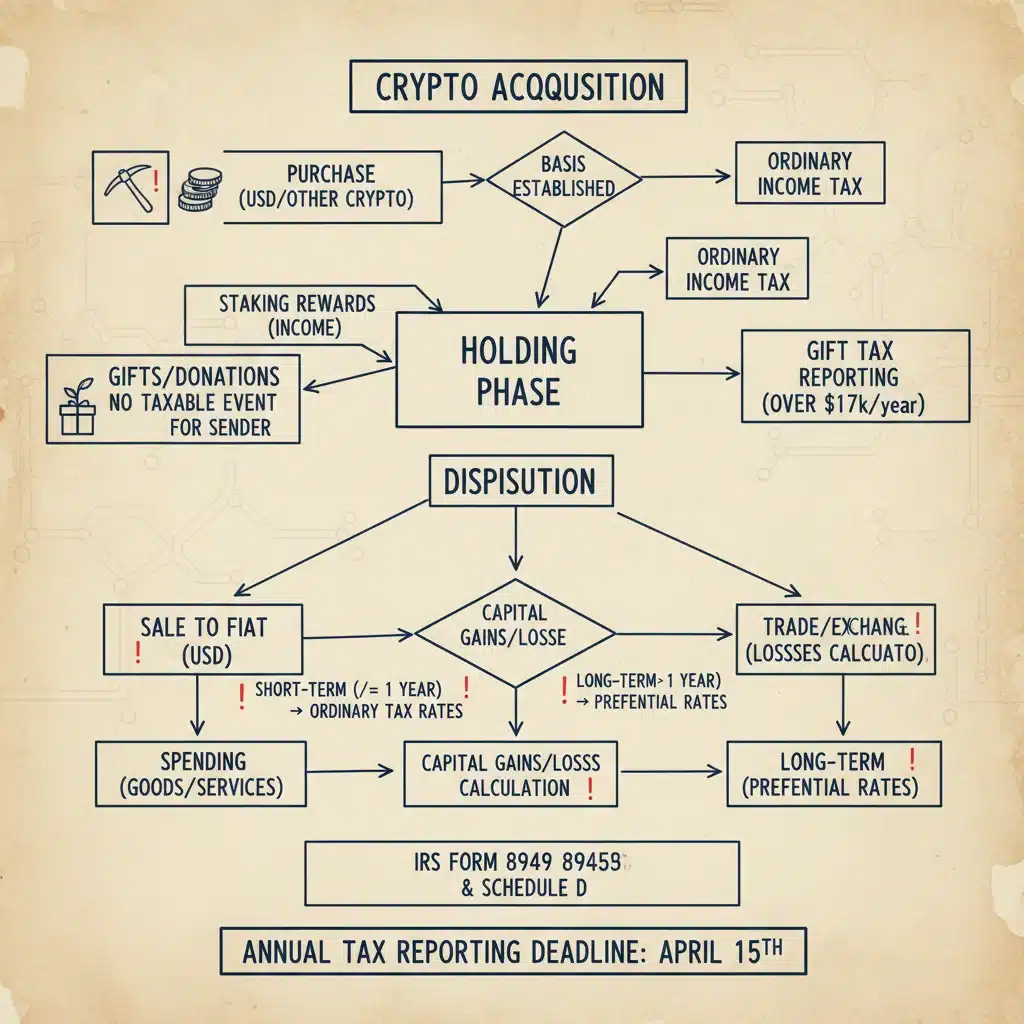
One of the most common misconceptions among cryptocurrency holders is that taxes only apply when crypto is converted back into fiat currency. This is often not the case. Many different types of transactions involving digital assets can trigger a taxable event, leading to capital gains or ordinary income that must be reported. Understanding these events is the cornerstone of effective Crypto Tax Compliance.
Common Taxable Events Include:
- Selling Cryptocurrency for Fiat Currency: This is the most straightforward taxable event. When you sell Bitcoin, Ethereum, or any other digital asset for USD, EUR, or another traditional currency, the difference between your cost basis (what you paid for it) and the sale price is generally considered a capital gain or loss.
- Trading One Cryptocurrency for Another: Exchanging Bitcoin for Ethereum, or any altcoin for another, is also a taxable event. The IRS, for example, treats this as a sale of the first cryptocurrency and a purchase of the second. The capital gain or loss is calculated based on the fair market value of the crypto you traded away at the time of the exchange. This is a crucial point often overlooked by new investors, leading to unexpected tax liabilities.
- Using Cryptocurrency to Purchase Goods or Services: When you use crypto to buy a coffee, a car, or any other product or service, it’s considered a disposition of the cryptocurrency. This means you are effectively selling your crypto at its fair market value at the time of the transaction to acquire the item. Any appreciation in the crypto’s value since you acquired it will be a capital gain.
- Receiving Cryptocurrency as Income: If you receive crypto as payment for services, as wages, or through mining and staking activities, it is generally considered ordinary income. The fair market value of the cryptocurrency at the time you receive it is the amount of income you must report. This also establishes your cost basis for future transactions involving that crypto.
- Airdrops and Forks: Receiving new cryptocurrency through an airdrop or a hard fork can also be a taxable event. The fair market value of the received crypto at the time of receipt is typically considered ordinary income.
It’s important to remember that not all crypto activities are taxable. For instance, simply holding cryptocurrency in your wallet, or transferring it between your own wallets, typically does not trigger a taxable event. However, the movement of assets can impact your cost basis calculations, so accurate record-keeping is still essential. Always consult with a tax professional to determine the specific tax implications of your unique crypto activities, particularly as 2026 approaches with its evolving regulations.
Calculating Your Digital Asset Gains and Losses
Accurately calculating your gains and losses is fundamental to proper Crypto Tax Compliance. This process involves determining your cost basis for each digital asset and comparing it to the fair market value at the time of a taxable event. The method you use to calculate your cost basis can significantly impact your tax liability, especially if you have made multiple purchases of the same cryptocurrency at different prices.
Cost Basis Methods:
- First-In, First-Out (FIFO): This method assumes that the first cryptocurrency you bought is the first one you sold. It’s often the default method used by tax software and exchanges if you don’t specify otherwise. FIFO can result in higher capital gains if the price of your asset has generally increased over time.
- Last-In, First-Out (LIFO): This method assumes that the last cryptocurrency you bought is the first one you sold. LIFO can be advantageous in a rising market, as it allows you to sell the most recently acquired (and often highest-priced) assets first, potentially reducing your taxable gains. However, not all jurisdictions explicitly allow LIFO for crypto.
- Specific Identification: This is generally the most tax-efficient method. It allows you to choose which specific units of cryptocurrency you are selling. For example, if you bought Bitcoin at $10,000, then again at $20,000, and then again at $30,000, and you sell some Bitcoin when the price is $25,000, you can choose to sell the units you acquired at $30,000 to realize a loss, or the units from $10,000 to realize a gain, depending on your tax strategy. This method requires meticulous record-keeping, as you must be able to identify the specific units sold.
The choice of cost basis method can have a profound impact on your tax outcome. It’s crucial to select a method that is permissible in your jurisdiction and aligns with your overall tax planning. Regardless of the method chosen, maintaining detailed records of every transaction is non-negotiable for robust Crypto Tax Compliance. This includes dates of acquisition and disposition, the fair market value of the crypto at the time of each transaction, and the purpose of the transaction.
Record-Keeping: Your Shield Against Penalties
Thorough and accurate record-keeping is the backbone of successful Crypto Tax Compliance. Without proper documentation, you risk misreporting your taxes, which can lead to audits, penalties, and interest charges. The onus is on the taxpayer to prove their reported figures, and in the complex world of crypto, this can be particularly challenging without a systematic approach.
Essential Records to Maintain:
- Acquisition Details: Date and time of purchase, cost in fiat currency or fair market value of traded crypto, quantity of crypto acquired, and the source (exchange, peer-to-peer, mining, gift, etc.).
- Disposition Details: Date and time of sale, fair market value received in fiat or crypto, quantity of crypto disposed of, and the purpose (sale, trade, purchase of goods, etc.).
- Transaction IDs and Wallet Addresses: These are crucial for tracing transactions on the blockchain and verifying your activities.
- Exchange Statements and Trade Histories: Download and keep all records from centralized exchanges you use.
- Mining/Staking Rewards: Dates, amounts, and fair market value at the time of receipt.
- Airdrop/Fork Information: Dates, amounts, and fair market value at the time of receipt.
- Fees: Any transaction fees incurred, which can often be added to your cost basis.
Consider using dedicated crypto tax software to automate the aggregation of your transaction data from various exchanges and wallets. These tools can help calculate your gains and losses using different cost basis methods, generate tax reports, and identify potential taxable events you might have overlooked. While software can significantly streamline the process, it’s still vital to review the generated reports for accuracy and ensure all your activities are captured. For 2026, with increased scrutiny expected, robust record-keeping will be your most valuable asset in demonstrating impeccable Crypto Tax Compliance.
Avoiding Common Pitfalls and Penalties
The consequences of non-compliance with cryptocurrency tax regulations can range from irritating to severe. Understanding the common pitfalls can help you steer clear of them and ensure you maintain a strong position regarding Crypto Tax Compliance.
Typical Mistakes Leading to Penalties:
- Underreporting or Failing to Report Gains: This is the most common and often most costly mistake. Any taxable event that results in a gain, whether it’s from selling, trading, or using crypto, must be reported.
- Incorrect Cost Basis Calculation: Errors in determining your cost basis can lead to either underpaying or overpaying taxes. While overpaying might seem less risky, it still means you’re not optimizing your financial position.
- Ignoring DeFi and NFT Transactions: The newer and more complex areas of crypto, like DeFi lending/borrowing or NFT sales, are often misunderstood from a tax perspective. Failing to report income or gains from these activities can trigger significant penalties.
- Lack of Proper Documentation: As discussed, inadequate records make it impossible to accurately report and defend your tax positions during an audit. This can result in the tax authority making assumptions that are not in your favor.
- Misunderstanding International Regulations: For individuals engaging in crypto activities across borders, failing to comply with foreign reporting requirements or understanding how different tax treaties apply can lead to complications.
- Treating Crypto as Currency (in jurisdictions where it’s not): Many tax authorities treat cryptocurrency as property, not currency. This distinction is crucial as it affects how gains and losses are calculated and reported. Treating it as currency when it’s considered property can lead to incorrect tax filings.
Penalties for Non-Compliance:
Penalties can vary significantly depending on the jurisdiction and the severity of the non-compliance. They can include:
- Accuracy-Related Penalties: For underpayments attributable to negligence or disregard of rules, or substantial understatement of income tax. These can be a percentage of the underpaid tax.
- Failure to File/Pay Penalties: If you don’t file your tax return on time or don’t pay the taxes you owe by the deadline, you can incur penalties.
- Fraud Penalties: In cases of intentional misrepresentation or evasion, penalties can be much higher, potentially including criminal charges and imprisonment.
- Interest Charges: On any unpaid taxes from the original due date until the date of payment.
The best way to avoid these severe consequences is to prioritize Crypto Tax Compliance. Seek professional advice, utilize reliable tax software, and maintain impeccable records from the outset of your crypto journey. As 2026 unfolds, regulators will be even more vigilant, making proactive compliance more important than ever.

Advanced Strategies for Optimizing Crypto Tax Compliance
Beyond basic reporting, there are several advanced strategies that can help you optimize your tax position and enhance your Crypto Tax Compliance efforts. These strategies often require careful planning and a deep understanding of tax law, making professional guidance invaluable.
Tax Loss Harvesting:
One of the most effective strategies for reducing your tax liability is tax loss harvesting. This involves intentionally selling digital assets at a loss to offset capital gains. If your capital losses exceed your capital gains, you can typically use a portion of those losses to offset ordinary income (up to a certain limit per year, with remaining losses often carried forward to future tax years). This strategy needs to be executed carefully, adhering to wash-sale rules (if applicable to crypto in your jurisdiction) and ensuring proper documentation. The end of the tax year is often a prime time for tax loss harvesting, but it can be done throughout the year.
Gifting and Estate Planning:
Gifting cryptocurrency can have tax implications for both the giver and the recipient. Understanding gift tax exemptions and reporting requirements is essential. Similarly, incorporating digital assets into your estate plan requires careful consideration of inheritance taxes and how these assets will be transferred to beneficiaries. Proper planning can help minimize future tax burdens for your heirs and ensure a smooth transition of assets.
Considering Tax-Advantaged Accounts:
While direct cryptocurrency investments in traditional tax-advantaged accounts like IRAs or 401(k)s are often restricted, there might be indirect ways to gain exposure through certain ETFs or trusts. Exploring these options, if available and compliant, could offer tax benefits. However, always verify the specific rules and regulations with a qualified financial advisor, as rules regarding crypto in retirement accounts are still evolving.
Understanding Long-Term vs. Short-Term Capital Gains:
The holding period of your cryptocurrency significantly impacts its tax treatment. Assets held for more than a year are typically subject to lower long-term capital gains tax rates, which can be a substantial advantage over short-term gains (assets held for a year or less) taxed at ordinary income rates. Strategic planning around holding periods can lead to considerable tax savings. This distinction is a cornerstone of effective Crypto Tax Compliance.
Professional Tax Advice:
Given the complexity and rapidly changing nature of cryptocurrency tax laws, engaging with a tax professional specializing in digital assets is highly recommended. They can provide personalized advice, help you navigate intricate regulations, assist with accurate reporting, and identify opportunities for tax optimization. A good tax advisor can be an invaluable partner in ensuring your Crypto Tax Compliance, especially as we move deeper into the 2026 tax year.
The Future of Crypto Tax Compliance Beyond 2026
The journey of Crypto Tax Compliance is not a one-time event but an ongoing process. As technology advances and governments gain a deeper understanding of the digital asset ecosystem, we can anticipate further refinements and expansions of tax regulations. The trend towards greater transparency and stricter enforcement is likely to continue.
Anticipated Future Trends:
- Global Harmonization: Efforts to standardize international crypto tax reporting frameworks may intensify, making cross-border compliance both easier in some aspects and more stringent in others.
- DeFi and DAO Specific Regulations: As decentralized finance (DeFi) and Decentralized Autonomous Organizations (DAOs) mature, expect more targeted regulations and specific tax guidance to address their unique structures and activities.
- Increased Use of AI and Blockchain Analytics: Tax authorities will continue to leverage advanced technologies to monitor blockchain transactions, identify non-compliant taxpayers, and enforce regulations more effectively.
- Education and Outreach: Governments may also increase their efforts to educate taxpayers on their crypto tax obligations, alongside their enforcement activities.
Staying ahead of these trends requires continuous learning and adaptability. Subscribing to regulatory updates, following reputable crypto tax news sources, and maintaining a relationship with a knowledgeable tax professional are all crucial steps. Your commitment to proactive Crypto Tax Compliance will not only protect you from penalties but also contribute to the long-term legitimacy and stability of the digital asset market.
Conclusion: Prioritizing Crypto Tax Compliance for a Secure Financial Future
As we’ve explored, navigating cryptocurrency taxation in 2026 is a multifaceted endeavor that demands diligence, accuracy, and a proactive approach. From understanding what constitutes a taxable event to meticulous record-keeping and leveraging advanced tax strategies, every step is vital for avoiding penalties and ensuring a secure financial future. The evolving regulatory landscape means that Crypto Tax Compliance is not a static challenge but an ongoing commitment.
The potential for significant gains in the digital asset space comes with the responsibility of adhering to tax laws. By embracing the principles outlined in this guide – staying informed, documenting every transaction, utilizing appropriate tools, and seeking expert advice when needed – you can confidently manage your crypto tax obligations. Don’t let the complexities deter you; instead, empower yourself with knowledge and strategic planning. Your proactive efforts today will safeguard your digital asset gains and provide peace of mind in the years to come. Remember, responsible investment includes responsible taxation. Make Crypto Tax Compliance a cornerstone of your digital asset strategy.