Maximize 2025 Retirement: 401(k) & IRA Limits Explained

Understanding and maximizing 401(k) and IRA contribution limits for 2025 is crucial for optimizing long-term retirement growth, offering strategic pathways to enhance your financial security and potentially achieve significant annual returns.
Are you ready to take control of your financial future and ensure a comfortable retirement? Understanding and effectively leveraging the latest contribution limits for 401(k) and IRA accounts is foundational to
maximizing retirement contributions. For 2025, these limits present a unique opportunity to significantly boost your savings and optimize long-term growth, potentially achieving an 8% annual return.
Understanding 401(k) and IRA Basics for 2025
Before diving into the specifics of maximizing contributions, it’s essential to grasp the fundamental nature of 401(k) and IRA accounts. These are not merely savings vehicles; they are powerful tools designed with tax advantages to encourage long-term investment for retirement. The differences between them, and their respective benefits, play a critical role in crafting a comprehensive retirement strategy.
A 401(k) is an employer-sponsored retirement plan, often featuring employer matching contributions, which can be a significant boost to your savings. IRAs, on the other hand, are individual retirement arrangements, giving you more direct control over your investments and offering options like traditional or Roth structures. Both are invaluable, but their optimal use often depends on your specific financial situation and retirement goals.
401(k) contribution limits and strategies
- Employee contributions: For 2025, the standard employee contribution limit for 401(k) plans is projected to be robust, allowing you to defer a substantial portion of your income pre-tax.
- Catch-up contributions: If you’re aged 50 or over, you’re eligible for additional catch-up contributions, providing a critical opportunity to accelerate your savings in the years leading up to retirement.
- Employer matching: Always aim to contribute at least enough to receive any employer match. This is essentially free money and provides an immediate, guaranteed return on your investment.
Beyond just meeting the limits, consider the allocation of your 401(k) investments. A well-diversified portfolio that aligns with your risk tolerance and time horizon is paramount for achieving that desired 8% annual growth. Rebalancing regularly helps maintain this alignment and capitalizes on market movements without undue risk.
IRA contribution limits and their strategic importance
Individual Retirement Arrangements (IRAs) serve as a vital complement to employer-sponsored plans, or as a primary retirement vehicle for those without access to a 401(k). For 2025, understanding the nuances of traditional versus Roth IRAs, along with their respective contribution limits, is key to optimizing your tax efficiency and long-term wealth accumulation.
Traditional IRAs offer tax-deductible contributions, meaning you pay taxes on your withdrawals in retirement. Roth IRAs, conversely, are funded with after-tax dollars, leading to tax-free withdrawals in retirement. The choice between them often hinges on your current income level, expected future tax bracket, and financial goals.
Traditional vs. Roth IRA: Which is right for you?
- Traditional IRA benefits: Contributions may be tax-deductible, reducing your taxable income in the present. This is particularly attractive if you expect to be in a lower tax bracket during retirement.
- Roth IRA advantages: Offers tax-free growth and withdrawals in retirement, provided certain conditions are met. Ideal if you anticipate being in a higher tax bracket later in life, or if you prefer tax diversification.
- Contribution limits: The IRA contribution limit for 2025 is expected to allow substantial annual contributions, alongside catch-up contributions for those aged 50 and over, similar to 401(k)s.
When deciding between a Traditional and Roth IRA, consider your current income and how it affects your eligibility for tax deductions or direct Roth contributions. Income phase-out limits can impact your ability to contribute directly to a Roth IRA, potentially necessitating strategies like the ‘backdoor Roth’ for higher earners. Consulting with a financial advisor can help navigate these complexities and ensure you make the most advantageous choice for your situation.
Strategies for maximizing your 2025 contributions
Simply knowing the contribution limits isn’t enough; actively implementing strategies to meet or exceed these limits is where true retirement optimization begins. This involves a combination of disciplined saving, strategic financial planning, and leveraging available tax advantages. The goal is not just to save, but to save smart, ensuring every dollar works as hard as possible for your future.
One of the most effective strategies is automating your contributions. Setting up automatic transfers from your paycheck or bank account directly into your retirement funds ensures consistency and helps you stay on track to hit your annual limits. This ‘set it and forget it’ approach removes the temptation to spend money that should be earmarked for retirement.
Advanced contribution tactics
- Mega backdoor Roth: If your 401(k) plan allows after-tax contributions, you might be able to contribute significantly more than the standard limit and then convert those funds to a Roth IRA, offering another avenue for tax-free growth.
- Spousal IRA: If one spouse earns little or no income, a spousal IRA allows them to contribute to an IRA based on the working spouse’s income, effectively doubling the household’s IRA contribution potential.
- Tax refunds and bonuses: Consider dedicating tax refunds, work bonuses, or other unexpected windfalls directly to your retirement accounts. These lump-sum contributions can help you reach your annual limits faster without impacting your regular budget.
Beyond these direct contribution methods, regularly reviewing your budget to identify areas where you can cut back and reallocate funds to retirement savings is crucial. Even small, consistent adjustments can add up to substantial differences over time, especially when compounded over decades. The earlier you start, and the more consistently you contribute, the greater the impact of compound interest on your retirement nest egg.
Optimizing for long-term growth: aiming for 8% annually
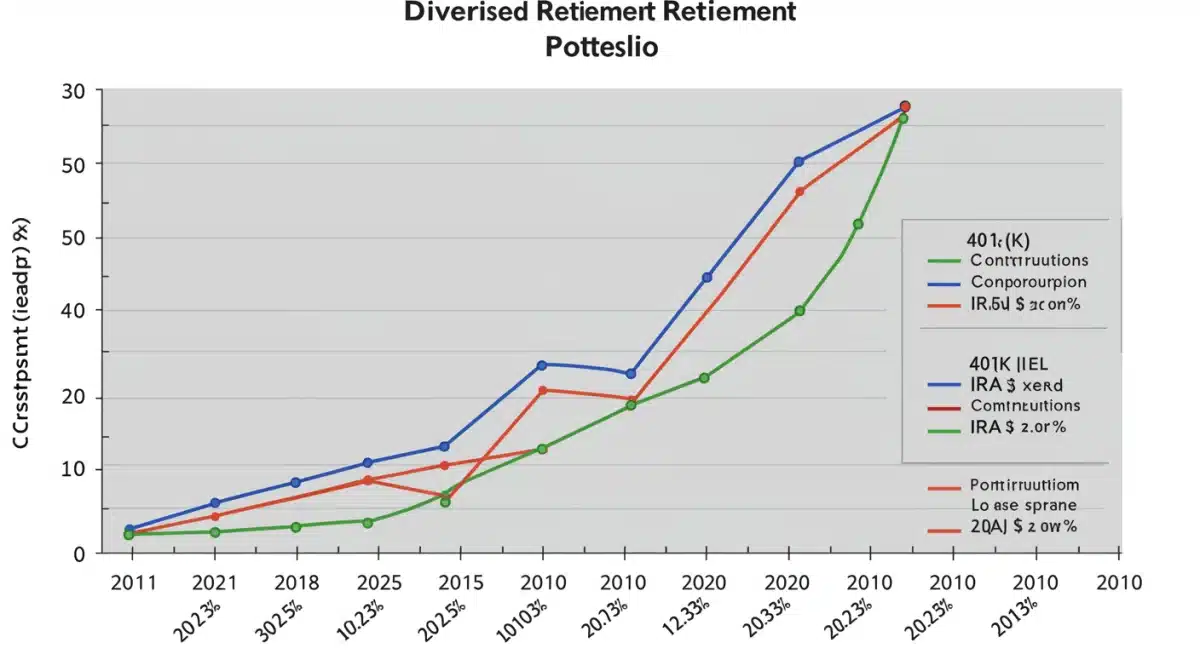
Achieving an 8% annual return on your retirement investments is an ambitious yet attainable goal for many, especially when employing a well-thought-out investment strategy and maintaining a long-term perspective. This growth rate significantly outpaces inflation and can lead to substantial wealth accumulation over decades. However, it requires careful asset allocation, diversification, and periodic reevaluation of your portfolio.
Diversification is not just about holding different types of investments; it’s about spreading your risk across various asset classes, industries, and geographies. This helps smooth out returns and protects your portfolio from significant downturns in any single market segment. A common approach involves a mix of equities (stocks) for growth and fixed income (bonds) for stability, adjusted according to your age and risk tolerance.
Investment strategies for enhanced returns
- Broad market index funds: These funds offer diversification at a low cost, tracking a wide segment of the market and historically delivering strong long-term returns.
- Growth stocks: Investing in companies with high growth potential can provide significant upside, though often comes with higher risk. Balancing these with more stable investments is key.
- Rebalancing: Periodically adjusting your portfolio back to its target asset allocation helps maintain your desired risk level and can capitalize on market movements by selling high and buying low.
The power of compound interest cannot be overstated in the pursuit of an 8% annual return. The earlier you start investing and the more consistently you contribute, the longer your money has to grow and earn returns on those returns. Even relatively small, consistent contributions can snowball into a significant sum over 20-30 years, illustrating why maximizing your contributions in 2025 is so critical for long-term success.
The impact of catch-up contributions for those 50 and over
For individuals aged 50 and older, catch-up contributions represent a powerful advantage in the race to retirement. These additional contributions allow you to significantly boost your savings beyond the standard limits, making up for lost time or simply accelerating your progress towards your financial goals. Ignoring these provisions means leaving potential tax-advantaged growth on the table.
The IRS recognizes that many individuals may not have been able to contribute as much as they would have liked earlier in their careers, or they might simply wish to supercharge their savings as retirement approaches. This is why catch-up contributions exist for both 401(k)s and IRAs, providing a valuable opportunity to add extra funds to your accounts.
Leveraging catch-up provisions effectively
- 401(k) catch-up: The additional amount you can contribute to your 401(k) once you turn 50 is substantial. This can dramatically increase your total annual contribution, especially if you also receive employer matching.
- IRA catch-up: Similarly, IRAs offer an additional catch-up contribution limit for those aged 50 and above, allowing for a greater influx of funds into either a Traditional or Roth IRA.
- Prioritizing catch-up: If you’re eligible, making catch-up contributions should be a high priority, especially after you’ve maxed out your standard contributions and any employer match.
Beyond just the numbers, the psychological benefit of catch-up contributions is significant. It can provide a sense of security and control, knowing that you are actively taking steps to bolster your retirement funds. It also allows for greater flexibility in your retirement planning, potentially enabling an earlier retirement or a more comfortable lifestyle during your golden years. These contributions are a testament to the fact that it’s never too late to make a significant positive impact on your financial future.
Tax implications and planning for retirement income
Understanding the tax implications of your retirement contributions and withdrawals is just as crucial as the contributions themselves. Effective tax planning can significantly enhance your net retirement income, allowing your savings to stretch further. The choices you make today regarding Traditional versus Roth accounts will dictate your tax burden in retirement, making informed decisions paramount.
For example, contributions to a Traditional 401(k) or IRA are typically pre-tax, reducing your current taxable income. However, withdrawals in retirement will be taxed as ordinary income. Conversely, Roth contributions are made with after-tax dollars, but qualified withdrawals in retirement are entirely tax-free. This distinction has profound implications for your long-term financial health.
Strategic tax considerations
- Tax diversification: Holding a mix of pre-tax (Traditional) and after-tax (Roth) accounts provides flexibility in retirement, allowing you to draw from different accounts to manage your taxable income each year.
- Required Minimum Distributions (RMDs): Traditional 401(k)s and IRAs are subject to RMDs, which begin at a certain age, forcing you to withdraw money and potentially increasing your taxable income. Roth IRAs, however, do not have RMDs for the original owner.
- Conversion strategies: Consider Roth conversions during years when you anticipate being in a lower tax bracket. This allows you to pay taxes now on a portion of your Traditional IRA or 401(k) and then enjoy tax-free growth and withdrawals later.
Beyond the individual accounts, consider how your retirement income will be generated from all sources, including Social Security, pensions, and other investments. A holistic view allows for a more effective tax strategy, potentially minimizing your overall tax liability throughout your retirement years. Proactive tax planning, rather than reactive, is key to preserving your wealth and maximizing your spending power in retirement.
| Key Point | Brief Description |
|---|---|
| 2025 Contribution Limits | Stay informed on the updated 401(k) and IRA limits to maximize your annual savings for retirement. |
| Catch-Up Contributions | Individuals aged 50 and over can contribute additional amounts to significantly boost their retirement savings. |
| Optimizing for Growth | Implement diversified investment strategies to target an 8% annual return, leveraging compound interest. |
| Tax-Efficient Planning | Utilize Traditional vs. Roth accounts strategically to manage your tax burden in retirement. |
Frequently Asked Questions About Retirement Contributions
While official limits are usually announced in late fall of the preceding year, projections for 2025 suggest an increase from 2024. It’s crucial to consult official IRS publications or your plan administrator for the most accurate and up-to-date figures as they become available.
Catch-up contributions allow individuals aged 50 and older to contribute an additional amount beyond the standard limits to their 401(k)s and IRAs. This provides a significant opportunity to boost retirement savings in the years leading up to retirement, making up for potentially lower contributions earlier in life.
Traditional IRA contributions may be tax-deductible, with withdrawals taxed in retirement. Roth IRA contributions are made with after-tax dollars, leading to tax-free withdrawals in retirement, provided certain conditions are met. The choice depends on your current and projected future tax bracket.
An 8% annual return is an ambitious but achievable target, especially over long periods with a well-diversified portfolio. It typically involves a balanced approach including growth-oriented assets like stocks. However, returns are not guaranteed and past performance does not indicate future results. It requires careful planning and risk management.
Generally, you should prioritize contributing enough to your 401(k) to receive any employer matching funds, as this is ‘free money.’ After that, decide between maximizing your 401(k) or IRA based on factors like investment options, fees, and your personal tax situation. A financial advisor can help tailor this decision to your needs.
Conclusion
Successfully navigating the landscape of retirement savings in 2025 hinges on a proactive and informed approach to 401(k) and IRA contributions. By understanding the updated limits, strategically employing catch-up provisions, and adopting diversified investment strategies, you can position yourself for significant long-term growth, potentially achieving an 8% annual return. Remember, consistent effort and smart financial choices today lay the groundwork for a secure and prosperous tomorrow, making your retirement dreams a tangible reality.