
Understanding and preparing for changes in healthcare costs is a crucial aspect of financial planning, especially for those relying on Medicare. As we look towards 2026, anticipating the potential adjustments to Medicare Part B 2026 premiums becomes a top priority for millions of beneficiaries. This comprehensive guide aims to demystify the factors influencing these costs, provide insights into what you can expect, and offer actionable strategies to help you navigate your healthcare expenses effectively.
The Landscape of Medicare Part B: What You Need to Know
Medicare Part B covers medically necessary services and preventive services. This includes doctor’s visits, outpatient care, durable medical equipment, and some home health services. While Part A (hospital insurance) is often premium-free for most people, Part B comes with a monthly premium. This premium can change annually, influenced by a variety of economic and legislative factors.
Anúncios
The Centers for Medicare & Medicaid Services (CMS) typically announces the exact premium amounts in the fall of the preceding year. However, understanding the underlying mechanisms that drive these costs can help you project and plan for your future financial obligations related to Medicare Part B 2026.
Key Factors Influencing Medicare Part B Premiums
Several critical elements contribute to the determination of Medicare Part B premiums each year:
- Healthcare Spending Trends: The overall cost of healthcare services, including new medical technologies, prescription drug costs, and utilization rates, significantly impacts premiums. If healthcare spending rises, premiums are likely to follow suit.
- Inflation: General economic inflation affects the cost of goods and services, including those in the healthcare sector. High inflation can lead to higher premiums.
- The Social Security Act: Specific provisions within the Social Security Act govern how Medicare premiums are calculated. For instance, the ‘hold harmless’ provision protects many beneficiaries from premium increases if their Social Security cost-of-living adjustment (COLA) is not large enough to cover the increase. However, this provision doesn’t apply to all beneficiaries, especially those who are new to Medicare, don’t receive Social Security benefits, or pay higher premiums due to their income.
- Income-Related Monthly Adjustment Amount (IRMAA): A significant factor for many, IRMAA means that higher-income beneficiaries pay a higher Part B premium. This adjustment is based on your modified adjusted gross income (MAGI) from two years prior. We will delve deeper into IRMAA shortly.
- Medicare Trust Funds: The financial health of the Medicare Supplementary Medical Insurance (SMI) Trust Fund, which pays for Part B benefits, also plays a role. Premiums are set to cover a portion of the projected costs of Part B services.
Projecting Medicare Part B Premiums for 2026
While specific numbers for Medicare Part B 2026 are not yet available, we can look at historical trends and current economic indicators to make informed projections. In recent years, premiums have generally seen moderate increases, though there have been exceptions. For example, significant increases occurred in some years due to factors like rising drug costs or adjustments to the ‘hold harmless’ provision.
Anúncios
Economic forecasts for the next few years will be critical. If inflation remains elevated, or if there are significant advancements in medical treatments that come with high costs, it could put upward pressure on premiums. Conversely, efforts to control healthcare spending or a stable economic environment could lead to more modest increases.
Understanding the ‘Hold Harmless’ Provision
The ‘hold harmless’ provision is a vital protection for many Medicare beneficiaries. It states that your Part B premium increase cannot be greater than the increase in your Social Security benefit. This means that if your Social Security COLA is, for example, $10, your Part B premium cannot increase by more than $10. However, it’s crucial to remember who this provision does NOT protect:
- New Medicare beneficiaries.
- Beneficiaries who do not receive Social Security benefits.
- Those who pay IRMAA (Income-Related Monthly Adjustment Amount).
- Beneficiaries whose Part B premiums are paid by Medicaid.
For those not protected by ‘hold harmless,’ premium increases can be more substantial, making proactive planning for Medicare Part B 2026 even more important.
The Impact of IRMAA on Your 2026 Premiums
The Income-Related Monthly Adjustment Amount (IRMAA) is perhaps the most significant factor that can cause your Medicare Part B 2026 premium to be higher than the standard amount. IRMAA affects beneficiaries whose modified adjusted gross income (MAGI) exceeds certain thresholds. These thresholds are adjusted annually for inflation, but the principle remains the same: the higher your income, the more you pay for Part B and Part D (prescription drug coverage).
How IRMAA is Calculated
IRMAA is based on your MAGI from two years prior. So, for your 2026 Medicare Part B premiums, the Social Security Administration (SSA) will typically look at your 2024 tax return. MAGI includes your adjusted gross income (AGI) plus tax-exempt interest income. It’s important to note that certain deductions and exclusions are added back to your AGI to arrive at MAGI for IRMAA purposes.
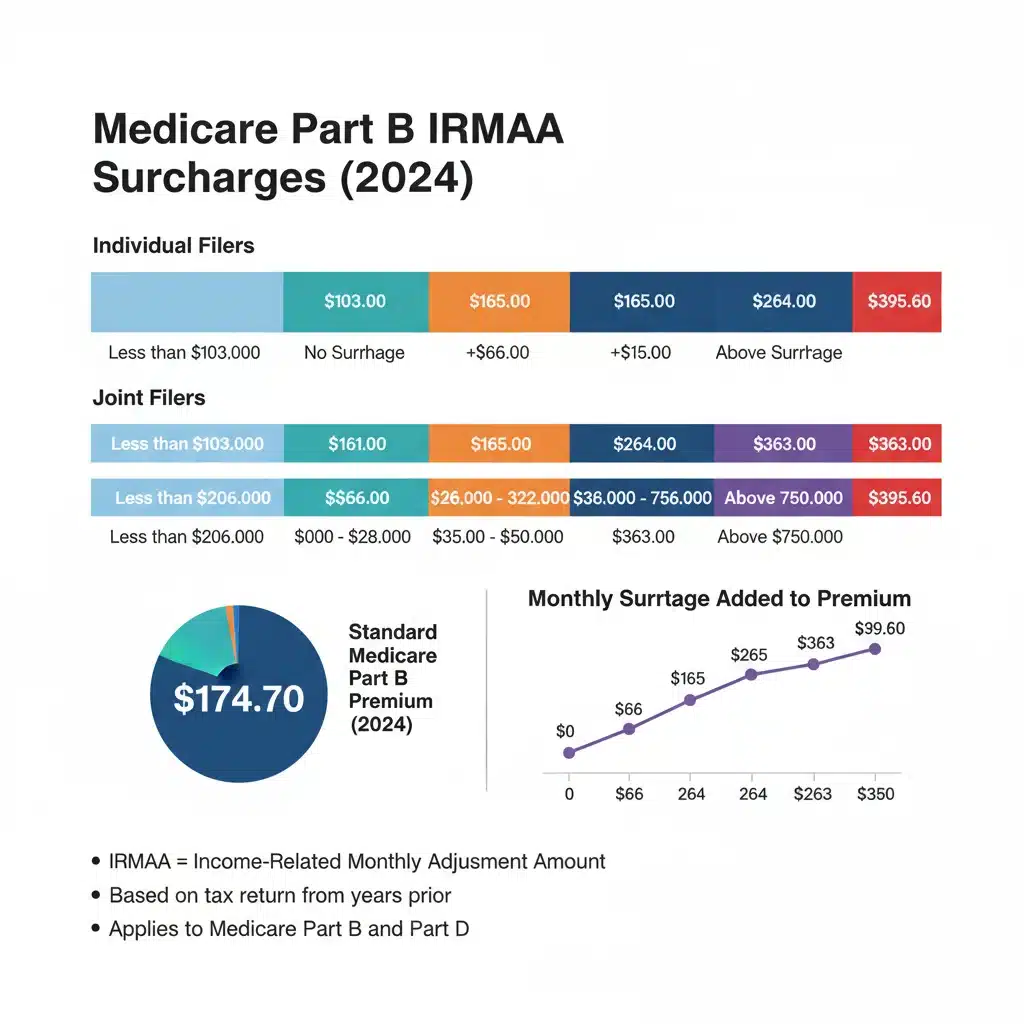
The income brackets for IRMAA are usually structured in tiers. As your MAGI crosses each threshold, you move into a higher tier and pay a larger surcharge on top of the standard Part B premium. For example, if the standard premium is $X, you might pay $X + $Y for the first tier, $X + $Z for the second, and so on, with ‘Y’ and ‘Z’ being the IRMAA surcharges.
Strategies to Potentially Mitigate IRMAA
Understanding that IRMAA looks at your income from two years prior gives you a window of opportunity to plan. While it’s challenging to drastically alter your income solely for Medicare purposes, some strategies can help reduce your MAGI and potentially lower your IRMAA:
- Tax Planning: Work with a financial advisor to optimize your tax strategy. This could involve maximizing pre-tax contributions to retirement accounts (like 401(k)s or traditional IRAs) if you are still working, or strategically managing withdrawals in retirement.
- Roth Conversions: While Roth conversions increase your taxable income in the year they occur, they can lead to tax-free withdrawals in retirement. This can be a long-term strategy to reduce your MAGI in future years, as Roth withdrawals generally don’t count towards MAGI for IRMAA calculations. However, be mindful of the immediate impact on IRMAA in the conversion year.
- Qualified Charitable Distributions (QCDs): If you are 70½ or older and have an IRA, you can make qualified charitable distributions directly from your IRA to an eligible charity. These distributions count towards your required minimum distributions (RMDs) but are not included in your MAGI, thus potentially lowering your IRMAA.
- Delaying Social Security: While not directly an IRMAA strategy, delaying Social Security can reduce your MAGI in early retirement years if you are relying on other income sources. However, this is a complex decision with many factors to consider.
- Life-Changing Events: If you experience a life-changing event that significantly reduces your income (e.g., retirement, divorce, death of a spouse, loss of income-producing property), you can appeal your IRMAA determination to the SSA. You will need to provide evidence of the event and your reduced income for the current year.
It is critical to consult with a financial planner or tax professional to assess how these strategies might apply to your specific situation and to understand their full implications for your overall financial plan and your Medicare Part B 2026 premiums.
Preparing for Your Medicare Part B 2026 Costs
Proactive preparation is key to managing your healthcare expenses in retirement. Here are several steps you can take:
1. Stay Informed About Policy Changes
Keep an eye on official announcements from CMS and the Social Security Administration. These agencies will provide the definitive figures for Medicare Part B 2026 premiums and IRMAA thresholds. Reputable financial news outlets and Medicare advocacy groups also offer valuable insights and analysis.
2. Review Your Income Annually
Since IRMAA is based on your income from two years prior, regularly review your tax returns and understand your MAGI. This allows you to project whether you might cross an IRMAA threshold and gives you time to implement income-management strategies if desired.
3. Budget for Potential Increases
Assume that Medicare Part B premiums will likely increase year over year. When creating your retirement budget, factor in a conservative estimate for these increases. This creates a buffer and helps prevent financial surprises.
4. Explore Medicare Advantage (Part C) or Medigap
While Part B is a fundamental component, how you receive your Medicare benefits can also impact your overall costs. Medicare Advantage plans (Part C) are offered by private companies approved by Medicare and may offer lower monthly premiums (sometimes even $0) and include prescription drug coverage and extra benefits. However, they often have network restrictions and different out-of-pocket costs.
Medigap (Medicare Supplement Insurance) plans help cover some of the ‘gaps’ in Original Medicare, such as deductibles, copayments, and coinsurance. If you have Original Medicare and a Medigap policy, your out-of-pocket costs for Part B services can be significantly reduced, though you pay a separate premium for the Medigap plan. Carefully evaluate whether a Medicare Advantage plan or Original Medicare with a Medigap policy is best for your healthcare needs and budget, considering the impact on your Medicare Part B 2026 expenses.
5. Consult with a Financial Advisor
A financial advisor specializing in retirement planning can be an invaluable resource. They can help you:
- Project future healthcare costs, including Medicare Part B 2026 premiums.
- Develop strategies to manage your income and potentially mitigate IRMAA.
- Integrate healthcare expenses into your overall retirement budget.
- Recommend appropriate investment strategies to fund these costs.

6. Understand Your Coverage Options
Beyond Part B premiums, it’s essential to understand your complete Medicare coverage. This includes Part A (hospital insurance), Part D (prescription drug coverage), and any supplemental plans like Medigap or Medicare Advantage. Each component has its own costs and benefits, and choosing the right combination can significantly affect your total healthcare spending.
- Part A (Hospital Insurance): Most people don’t pay a monthly premium for Part A if they or their spouse paid Medicare taxes for a certain period. However, there are deductibles and coinsurance for hospital stays.
- Part D (Prescription Drug Coverage): This is provided by private insurance companies approved by Medicare. Like Part B, Part D premiums can also be subject to IRMAA. It’s crucial to compare Part D plans annually during the Open Enrollment Period to ensure you have the most cost-effective coverage for your prescriptions.
The Future of Medicare: Potential Reforms and Their Impact
The long-term solvency of Medicare is a recurring topic in national policy discussions. As the population ages, the number of beneficiaries grows, putting pressure on the system. While specific reforms for 2026 are not definitive, discussions often revolve around:
- Means-testing: Further expanding IRMAA to more income brackets or increasing the surcharges for higher earners.
- Premium support: A system where the government provides a fixed contribution towards healthcare coverage, and beneficiaries choose plans that fit their needs and budget.
- Negotiating drug prices: Allowing Medicare to negotiate prescription drug prices directly, which could potentially lower costs for beneficiaries and the program.
- Raising the eligibility age: A more controversial proposal, but one that surfaces periodically.
Any significant legislative changes could impact the structure and cost of Medicare Part B 2026 and beyond. Staying informed about these broader policy debates can provide additional context for your planning.
Common Misconceptions About Medicare Part B Premiums
Dispelling common myths can help you better understand and prepare for your Medicare costs:
- Myth: My Part B premium will always be the standard amount.
Reality: Not necessarily. Your income (IRMAA) and whether you are protected by the ‘hold harmless’ provision can significantly alter your premium. - Myth: Medicare is free after I’ve paid into it.
Reality: While Part A is often premium-free, Part B and Part D (and often Medigap or Medicare Advantage) all come with premiums, deductibles, and other out-of-pocket costs. - Myth: I don’t need to worry about Medicare costs until I turn 65.
Reality: Planning for healthcare expenses, including future Medicare premiums, should be an integral part of your retirement financial planning well before you become eligible. - Myth: All Medicare Advantage plans are the same.
Reality: Medicare Advantage plans vary widely in terms of premiums, deductibles, networks, and covered benefits. It’s essential to research and compare plans annually.
Actionable Steps for Today
To ensure you are well-prepared for Medicare Part B 2026 and beyond, consider these immediate actions:
- Review Your 2024 Income: If you’re still working or have significant investments, understand how your 2024 MAGI might impact your 2026 IRMAA.
- Set Up a Healthcare Savings Account (HSA) if Eligible: If you are on a high-deductible health plan (HDHP) and not yet on Medicare, an HSA is a powerful tool for saving for future healthcare costs, including Medicare premiums. Funds grow tax-free, and withdrawals for qualified medical expenses are also tax-free.
- Build an Emergency Fund: Having a robust emergency fund can help cover unexpected medical costs not fully covered by Medicare, providing peace of mind.
- Educate Yourself: Utilize resources from CMS, the Social Security Administration, and trusted financial planning sites to deepen your understanding of Medicare.
Conclusion
The prospect of new Medicare Part B premiums for 2026 might seem daunting, but with a clear understanding of the factors involved and proactive planning, beneficiaries can effectively manage their healthcare costs. By staying informed about potential changes, understanding the impact of IRMAA, and exploring all available coverage options, you can build a robust financial strategy that accounts for your future healthcare needs. Remember, your financial health is as important as your physical health, and careful preparation for Medicare Part B 2026 is a vital step in securing a comfortable and healthy retirement.