Micro-Credentialing vs. Traditional Degrees: 2025 US Job Market Analysis

Anúncios
The US job market in 2025 is increasingly valuing micro-credentials for specialized skills, offering a faster, more flexible alternative to traditional degrees while both pathways present distinct advantages and challenges for career advancement.
As the landscape of employment continues its rapid evolution, a pivotal question emerges for aspiring professionals and seasoned workers alike: how will micro-credentialing vs. traditional degrees shape career trajectories in the 2025 US job market? The answer is complex, reflecting a dynamic interplay of employer demands, technological advancements, and individual learning preferences.
Anúncios
The rise of micro-credentials: a new educational paradigm
Micro-credentials have rapidly moved from a niche concept to a mainstream educational force, offering focused, verifiable recognition of specific skills or competencies. This shift is largely driven by the accelerating pace of technological change and the need for a workforce that can adapt quickly.
These shorter, more targeted programs stand in stark contrast to the broader, often lengthier commitment required for traditional degrees. They respond directly to the demand for just-in-time learning, allowing individuals to acquire relevant skills without disrupting their careers or incurring significant debt.
Anúncios
defining micro-credentials
Micro-credentials encompass a wide array of certifications, badges, and specialized courses. They are typically offered by universities, industry associations, and private training providers. The key characteristic is their focus on a narrow set of competencies.
- focused skill acquisition: designed to teach specific, in-demand skills.
- flexible learning paths: often self-paced and online, fitting into busy schedules.
- industry relevance: content frequently developed in collaboration with employers.
- verifiable outcomes: often include assessments to prove mastery of the skill.
The appeal lies in their agility; they can be developed and updated much faster than traditional degree programs, ensuring that the skills taught remain current and valuable in a rapidly changing market. This makes them particularly attractive in fields like technology, data science, and digital marketing.
In conclusion, micro-credentials represent a significant departure from conventional education, prioritizing efficiency, specificity, and immediate applicability. Their growth signals a fundamental re-evaluation of what constitutes valuable professional preparation in a competitive job market.
Traditional degrees: enduring value in a changing world
Despite the ascendancy of micro-credentials, traditional bachelor’s, master’s, and doctoral degrees continue to hold substantial weight in the US job market. Their enduring value stems from a comprehensive educational experience that goes beyond specific technical skills, fostering critical thinking, problem-solving, and a broad understanding of various disciplines.
Employers often look for the foundational knowledge and soft skills that a traditional degree typically provides, viewing it as a robust indicator of an individual’s intellectual capacity and long-term potential.
the comprehensive advantage
Traditional degrees offer a holistic educational journey, encompassing general education requirements alongside specialized major coursework. This broad exposure is designed to cultivate well-rounded individuals capable of adapting to diverse professional challenges.
- foundational knowledge: builds a strong base in various academic areas.
- critical thinking skills: develops analytical and problem-solving abilities.
- networking opportunities: provides extensive connections with peers and faculty.
- structured career pathways: often a prerequisite for many professional roles.
The structured nature of traditional degree programs often includes internships, research opportunities, and capstone projects that provide practical experience and a deeper understanding of a chosen field. These experiences are invaluable for developing a professional identity and building a portfolio.
Furthermore, many industries and professions, such as medicine, law, and engineering, still mandate traditional degrees due to regulatory requirements and the complex body of knowledge they entail. This institutional backing ensures their continued relevance in specific sectors.
Ultimately, traditional degrees offer a depth of learning and a breadth of experience that micro-credentials, by their very design, cannot fully replicate. They remain a cornerstone for many career paths, particularly those requiring extensive theoretical understanding and long-term professional development.
The 2025 US job market: employer perspectives
The US job market in 2025 is characterized by a nuanced approach to hiring, where employers increasingly value a blend of educational backgrounds. While some roles will continue to prioritize traditional degrees, a growing number are recognizing the immediate utility and specialized expertise offered by micro-credentials.
This evolving perspective reflects a pragmatic need to fill skill gaps rapidly and efficiently, particularly in tech-driven sectors. Employers are looking for demonstrable skills, regardless of the pathway taken to acquire them.
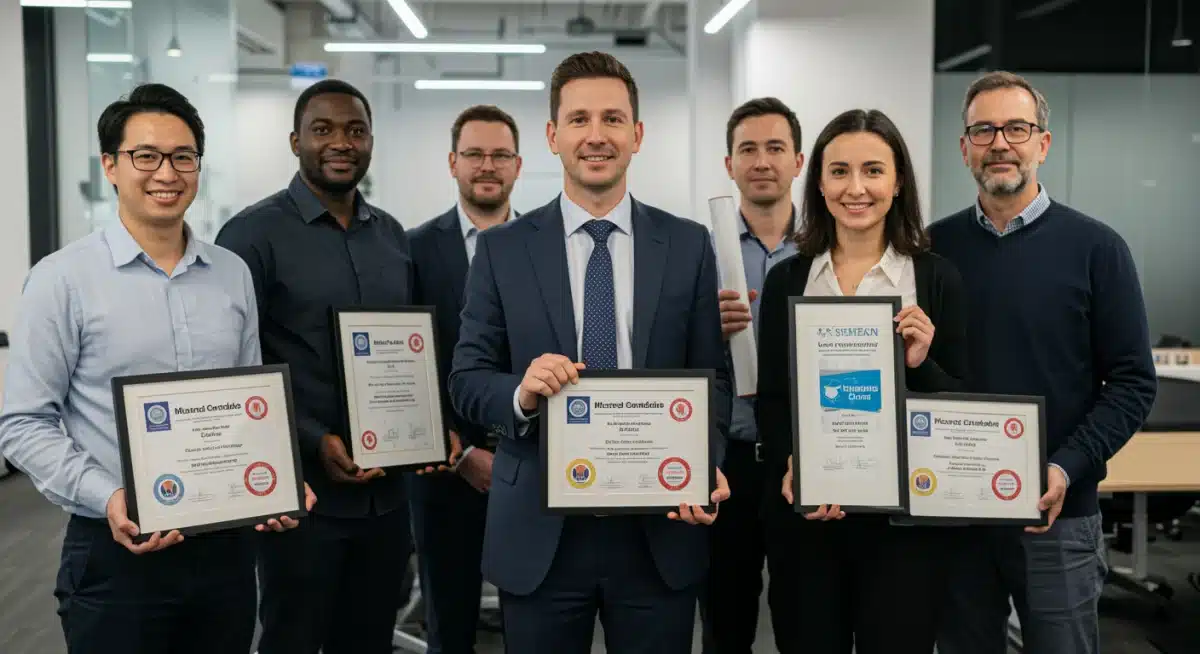
One key trend is the move towards skills-based hiring, where competencies take precedence over formal qualifications. This doesn’t completely diminish the value of degrees but instead broadens the pool of qualified candidates.
adapting to skill demands
Companies are facing a constant need to upskill and reskill their workforces. Micro-credentials offer a flexible solution for existing employees to gain new competencies, and for new hires to prove specialized abilities.
- tech sector: high demand for specific coding, data science, and cybersecurity micro-credentials.
- healthcare: specialized certifications for new medical technologies or administrative roles.
- manufacturing: advanced certifications in automation and robotics are gaining traction.
- marketing: digital marketing, SEO, and social media analytics micro-credentials are highly valued.
However, employers also recognize that traditional degrees often signify a candidate’s ability to commit to long-term goals, engage in complex problem-solving, and possess strong communication skills—qualities that are universally valuable.
The ideal candidate in 2025 often possesses a foundational degree complemented by a stack of relevant micro-credentials, showcasing both breadth of knowledge and specialized expertise. This hybrid approach allows individuals to be both versatile and highly skilled in specific areas.
In essence, employers are becoming more open-minded about educational pathways, seeking evidence of capability and a proactive approach to learning. The future workforce will likely be a mosaic of diverse educational backgrounds, each contributing unique strengths.
Career pathways: navigating the educational landscape
For individuals, choosing between a traditional degree and micro-credentials (or a combination of both) requires careful consideration of career goals, financial resources, and personal learning styles. Each pathway presents distinct advantages and limitations in the pursuit of professional advancement.
The decision is no longer a simple binary choice but a strategic one, influenced by industry demands and individual aspirations. Understanding the implications of each route is crucial for effective career planning in 2025.
strategic educational choices
A traditional degree often serves as a robust entry point into many professional fields, providing a broad theoretical framework and opening doors to management and leadership roles. It’s a significant investment, but one that historically yields substantial returns over a career lifetime.
- long-term career growth: often a prerequisite for senior positions and promotions.
- broader skill set: develops transferable skills valuable across industries.
- academic foundation: prepares individuals for further graduate studies and research.
- industry recognition: still widely accepted as a standard for professional competence.
Conversely, micro-credentials offer a faster, more agile route to acquiring specific, in-demand skills. They are ideal for reskilling, upskilling, or pivoting into new areas without the time and financial commitment of a full degree. They can provide immediate employability in specialized roles.
Many professionals are now opting for a blended approach: earning a traditional degree for foundational knowledge and then continuously adding micro-credentials to stay current with industry trends and acquire new proficiencies. This strategy combines the best of both worlds, ensuring both depth and agility.
Ultimately, the most effective career pathway in 2025 will be one that is tailored to individual circumstances and responsive to the evolving needs of the job market, leveraging the strengths of both traditional and modern educational offerings.
The impact on workforce development and lifelong learning
The interplay between micro-credentials and traditional degrees is fundamentally reshaping workforce development strategies and reinforcing the imperative of lifelong learning. In 2025, continuous skill acquisition is not merely an advantage but a necessity for staying competitive and adaptable in a dynamic economy.
Educational institutions, employers, and individuals are all adjusting to this new paradigm, recognizing that learning can no longer be confined to a single period of formal education.
fostering continuous education
Micro-credentials are at the forefront of this shift, enabling workers to continuously update their skill sets in response to technological advancements and changing job requirements. This modular approach to learning makes it easier for individuals to integrate education with their professional lives.
- corporate training: companies are partnering with providers to offer micro-credential programs to employees.
- reskilling initiatives: government and industry programs leveraging micro-credentials to transition workers into new fields.
- personal development: individuals proactively seeking micro-credentials to enhance their resumes and career prospects.
- flexible pathways: creating accessible routes for individuals who cannot pursue traditional degrees.
Traditional institutions are also evolving, integrating micro-credentials into their degree programs or offering them as standalone options. This hybrid model acknowledges the value of both comprehensive education and targeted skill development.
The emphasis on lifelong learning means that educational attainment is no longer a terminal event but an ongoing process. Individuals are expected to be proactive in identifying skill gaps and pursuing relevant training, whether through formal degrees or agile micro-credentials.
This continuous engagement with learning not only benefits individual careers but also strengthens the overall workforce, ensuring that the US economy remains robust and innovative in the face of global challenges.
Challenges and opportunities for the future
While the coexistence of micro-credentials and traditional degrees offers numerous benefits, it also presents distinct challenges and opportunities that will shape the future of education and employment. Navigating these complexities will be crucial for individuals, educators, and employers alike in the coming years.
The evolving landscape demands thoughtful strategies to ensure equity, quality, and recognition across all educational pathways, fostering a truly inclusive and effective talent ecosystem.
addressing key considerations
One significant challenge is the standardization and recognition of micro-credentials. Without clear benchmarks, employers may struggle to evaluate the quality and relevance of various offerings. This necessitates industry collaboration and transparent credentialing processes.
- quality assurance: developing consistent standards for micro-credential programs.
- credential stacking: creating clear pathways for combining micro-credentials into larger qualifications.
- equity of access: ensuring that diverse populations have access to both degree and micro-credential opportunities.
- employer integration: educating employers on the value and verification of micro-credentials.
Another area of opportunity lies in the potential for micro-credentials to democratize education, making specialized training more accessible to individuals who may not have the time or resources for a traditional degree. This could lead to a more diverse and skilled workforce.
Furthermore, the integration of artificial intelligence and other emerging technologies will continue to influence skill demands, making the agile nature of micro-credentials even more critical for rapid adaptation. Educational institutions must remain responsive to these changes, ensuring their curricula, both traditional and modular, remain relevant.
The future educational ecosystem will be a dynamic interplay of traditional depth and micro-credential agility, requiring continuous innovation and collaboration to meet the evolving needs of the US job market. The key will be to harness the strengths of both to create a resilient and adaptable workforce.
| Key Aspect | Description in 2025 US Job Market |
|---|---|
| Skill Focus | Micro-credentials target specific, in-demand skills; traditional degrees offer broader foundational knowledge. |
| Employer Value | Employers increasingly value both, often seeking a blend of foundational degrees and specialized micro-credentials. |
| Career Agility | Micro-credentials enable rapid upskilling/reskilling; traditional degrees are foundational for long-term career growth. |
| Lifelong Learning | Both contribute to continuous education, with micro-credentials offering modular flexibility for ongoing development. |
Frequently asked questions about educational pathways
No, micro-credentials are not entirely replacing traditional degrees. Instead, they are complementing them, offering alternative and supplementary pathways to skill acquisition. Many employers in 2025 value a combination of both, recognizing the distinct strengths each brings to the workforce.
The ‘better’ option depends on individual career goals and industry. Traditional degrees often provide a broader foundation for long-term career growth and leadership roles. Micro-credentials are excellent for rapid skill acquisition, career pivots, or staying current in specialized fields. A blended approach is increasingly common.
US employers in 2025 are increasingly recognizing the value of micro-credentials for specific, in-demand skills. While some traditional industries still prefer degrees, many tech-driven sectors and innovative companies prioritize demonstrable skills, often acquired through micro-credentials, alongside foundational education.
Yes, micro-credentials can lead to higher salaries, particularly when they provide highly specialized and in-demand skills. They can enable individuals to qualify for roles with better compensation or negotiate higher pay in their current positions by demonstrating enhanced expertise in critical areas.
A blended learning approach, combining traditional degrees with micro-credentials, offers the best of both worlds. It provides a strong foundational knowledge base, critical thinking skills, and specialized, up-to-date competencies. This makes individuals versatile, adaptable, and highly competitive in the 2025 job market.
Conclusion
The 2025 US job market is undeniably a landscape shaped by both the enduring value of traditional degrees and the agile rise of micro-credentials. Neither pathway is singularly superior; rather, their combined strengths offer a robust framework for career development and workforce adaptability. For individuals, strategic educational choices will involve understanding their career aspirations and leveraging the appropriate learning opportunities—be it a comprehensive degree, targeted micro-credentials, or a synergistic blend of both. Employers, in turn, are increasingly adopting a skills-first mindset, recognizing that a diverse array of educational backgrounds contributes to a more innovative and resilient workforce. The future of education and employment in the US is one of continuous learning, characterized by flexibility, specialization, and a profound commitment to lifelong skill development.