Student Loan Refinancing 2026: Rates, Strategies & Debt Reduction

Anúncios
Student Loan Refinancing in 2026: Current Rates and Strategies for Debt Reduction
Student loan debt continues to be a significant financial burden for millions across the globe. As we navigate 2026, understanding the landscape of student loan refinancing is more crucial than ever. With economic shifts, evolving interest rates, and new lender offerings, staying informed can be the key to unlocking substantial savings and achieving financial freedom. This comprehensive guide will delve into the current state of student loan refinancing, exploring prevailing interest rates, essential eligibility criteria, and effective strategies to reduce your debt.
The decision to refinance student loans is not one to be taken lightly. It involves careful consideration of your financial situation, future goals, and the potential benefits and drawbacks. Our aim is to equip you with the knowledge needed to make an informed choice, potentially saving you thousands of dollars over the life of your loans and accelerating your path to becoming debt-free.
Anúncios
What is Student Loan Refinancing?
At its core, student loan refinancing involves taking out a new private loan to pay off one or more existing student loans. This new loan typically comes with a new interest rate and new terms. The primary goal of refinancing is almost always to secure a lower interest rate, which can lead to lower monthly payments, a reduced total cost of the loan over time, or both. It can also simplify your finances by consolidating multiple loans into a single, more manageable payment.
It’s important to distinguish refinancing from consolidation. While both combine multiple loans, federal student loan consolidation combines federal loans into a new federal loan, maintaining federal benefits. Refinancing, on the other hand, involves a private lender and replaces your existing federal or private loans with a new private loan. This means you would lose federal loan benefits such as income-driven repayment plans, deferment, forbearance, and potential loan forgiveness programs if you refinance federal loans.
Anúncios
Why Consider Student Loan Refinancing in 2026?
- Lower Interest Rates: The most compelling reason for many. If interest rates have dropped since you took out your original loans, or if your credit score has significantly improved, you could qualify for a much lower rate.
- Reduced Monthly Payments: A lower interest rate or an extended repayment term (though this might increase the total cost) can make your monthly payments more affordable.
- Simplify Payments: Juggling multiple student loans with different due dates and servicers can be a headache. Refinancing consolidates them into one loan with a single payment.
- Change Loan Terms: You might switch from a variable interest rate to a fixed rate for predictability, or vice versa if you believe rates will continue to fall. You can also adjust the loan term to better suit your financial goals.
Current Student Loan Refinancing Rates in 2026
The interest rate environment is a dynamic factor in the world of student loan refinancing. In 2026, we are seeing a landscape influenced by several key economic indicators, including the Federal Reserve’s monetary policy, inflation rates, and the overall health of the economy. While specific rates are constantly fluctuating, we can observe general trends and averages.
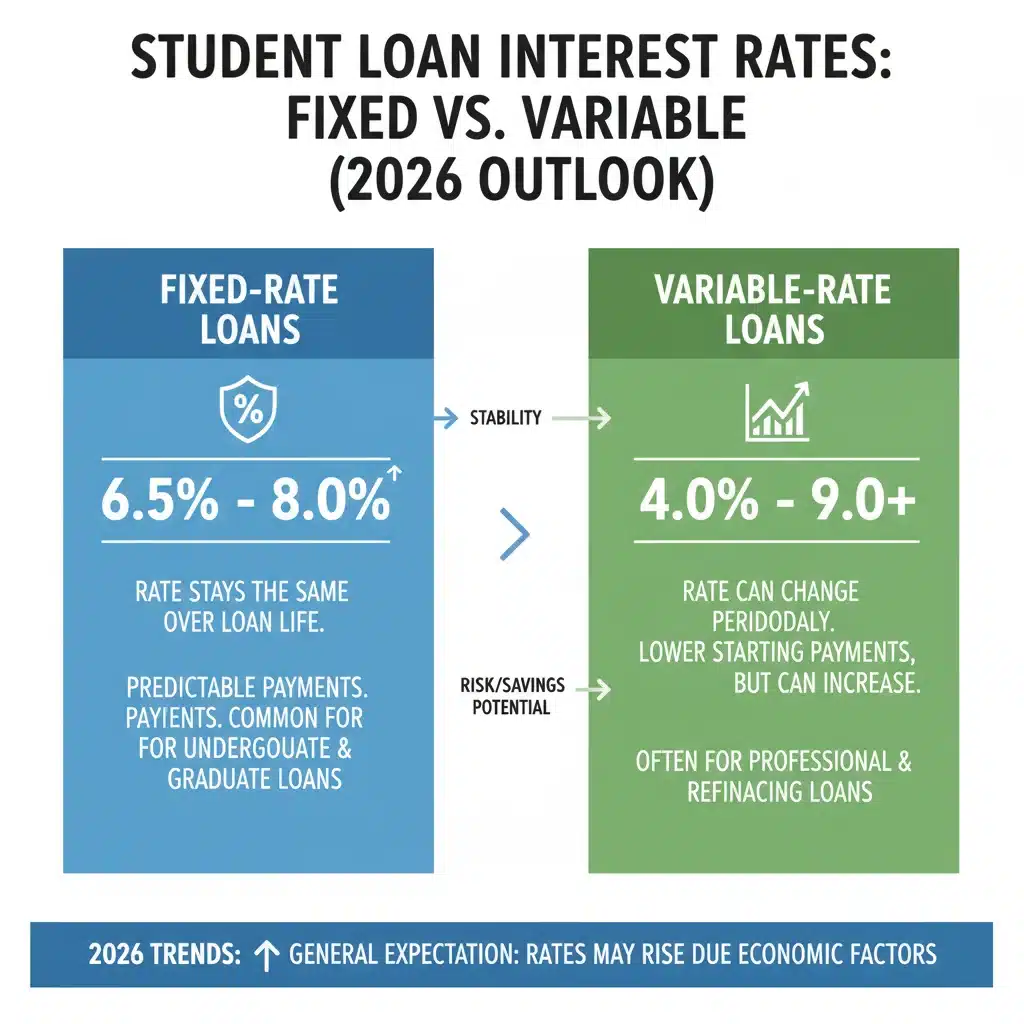
As of mid-2026, fixed interest rates for refinanced student loans generally range from 4.5% to 8.0%, depending heavily on the borrower’s creditworthiness and the loan term. Variable rates, while often starting lower, typically fall between 3.0% and 7.5%. These ranges are broad because individual rates are tailored to each applicant’s financial profile.
Several factors will influence the rate you are offered:
- Credit Score: A strong credit score (typically 700+) is paramount. Lenders view borrowers with excellent credit as lower risk, offering them the most favorable rates.
- Income and Employment History: Lenders want to ensure you have a stable income to comfortably make your monthly payments. A consistent employment history demonstrates reliability.
- Debt-to-Income Ratio: This ratio compares your monthly debt payments to your gross monthly income. A lower ratio indicates you have more disposable income to cover new debt.
- Loan Term: Shorter loan terms usually come with lower interest rates because the lender’s risk is reduced. Longer terms, while offering lower monthly payments, often have higher interest rates.
- Cosigner: If you have a less-than-perfect credit score or limited income, a creditworthy cosigner can significantly improve your chances of approval and help you secure a lower interest rate.
It’s crucial to shop around and compare offers from multiple lenders. Each lender has its own underwriting criteria and rate structures, so what one lender offers might be vastly different from another.
Eligibility Requirements for Student Loan Refinancing
While the allure of lower interest rates is strong, not everyone qualifies for student loan refinancing. Lenders have specific criteria they use to assess risk and determine eligibility. Understanding these requirements before you apply can save you time and potential disappointment.
Common Eligibility Criteria:
- Good to Excellent Credit Score: As mentioned, this is perhaps the most critical factor. Most lenders look for a FICO score of 650 or higher, with the best rates reserved for those with scores above 700 or even 750.
- Stable Income and Employment: You’ll need to demonstrate a consistent income stream that is sufficient to cover your living expenses and all your debt payments, including the new refinanced loan. Lenders typically require proof of employment, often through pay stubs or tax returns.
- Low Debt-to-Income (DTI) Ratio: Your DTI ratio is a key indicator of your financial health. Lenders prefer a DTI below 50%, and ideally even lower, as it suggests you’re not overextended with debt.
- Graduation from an Accredited School: Most lenders require that you have graduated with a degree from an eligible, accredited institution. Some may consider borrowers who did not graduate but have made significant progress in their studies and meet other strong financial criteria.
- U.S. Citizenship or Permanent Residency: Typically, you must be a U.S. citizen or permanent resident to qualify for refinancing. Some lenders may offer options for international students with a qualified U.S. citizen or permanent resident cosigner.
- Minimum Loan Amount: Lenders usually have a minimum amount they are willing to refinance, often ranging from $5,000 to $10,000.
Even if you don’t meet all these criteria individually, having a cosigner who does can significantly boost your chances of approval. A cosigner shares responsibility for the loan, providing an added layer of security for the lender.
Strategies for Effective Student Loan Debt Reduction
Refinancing is a powerful tool, but it’s just one component of a broader strategy for effective student loan debt reduction. To maximize your savings and accelerate your path to debt freedom, consider integrating these strategies:
1. Compare Offers from Multiple Lenders
This cannot be stressed enough. Don’t settle for the first offer you receive. Use online marketplaces or directly apply to several lenders to get pre-qualified rates. Pre-qualification usually involves a soft credit check, which won’t impact your credit score, allowing you to compare personalized rates without commitment. Look at not just the interest rate, but also the loan terms, fees, and customer service reviews.
2. Choose the Right Loan Term
When you refinance, you’ll typically have options for the loan term (e.g., 5, 7, 10, 15, or 20 years). A shorter term usually means a higher monthly payment but significantly less interest paid over the life of the loan. A longer term offers lower monthly payments, which can be beneficial if you’re struggling financially, but it will cost you more in interest in the long run. Balance affordability with your long-term financial goals.
3. Fixed vs. Variable Interest Rates
Deciding between a fixed and variable interest rate is a critical choice. A fixed rate remains the same for the entire life of the loan, providing predictability and stability. A variable rate can fluctuate with market conditions (often tied to the prime rate or LIBOR), potentially going up or down. Variable rates usually start lower than fixed rates, but they carry the risk of increasing, which could raise your monthly payments. Choose a fixed rate if you prioritize stability, or a variable rate if you’re comfortable with risk and believe rates will remain low or decrease.
4. Make Extra Payments
Once you’ve refinanced, any extra payments you make go directly towards reducing your principal balance. This can significantly shorten your loan term and save you a substantial amount in interest. Even small, consistent extra payments can make a big difference over time. Consider allocating bonuses, tax refunds, or any unexpected windfalls to your student loans.
5. Set Up Autopay
Many lenders offer a small interest rate discount (typically 0.25%) for setting up automatic payments. This not only saves you a bit of money but also ensures you never miss a payment, which is crucial for maintaining a good credit score.
6. Understand the Impact on Federal Loan Benefits
If you’re considering refinancing federal student loans, be acutely aware that you will lose access to federal protections and benefits. These include income-driven repayment plans, public service loan forgiveness, and flexible deferment and forbearance options. For some, the lower interest rate of a private refinance outweighs these benefits, but for others, especially those in public service or with unstable incomes, retaining federal benefits is paramount. Carefully weigh this trade-off.

The Refinancing Application Process in 2026
The application process for student loan refinancing has become increasingly streamlined in 2026, with most lenders offering online applications. Here’s a general overview of what to expect:
1. Gather Your Documents
Before you start, collect all necessary documentation. This typically includes:
- Proof of identity (driver’s license, passport)
- Proof of income (pay stubs, W-2s, tax returns)
- Loan statements for all student loans you wish to refinance
- Proof of graduation or enrollment (transcripts, diploma)
- Bank statements
2. Get Pre-Qualified
As mentioned, start by getting pre-qualified with multiple lenders. This allows you to see potential rates and terms without a hard credit inquiry. Many online platforms allow you to compare offers from various lenders side-by-side.
3. Submit Your Application
Once you’ve chosen a lender, you’ll complete a full application. This will involve a hard credit inquiry, which might temporarily ding your credit score by a few points. Be thorough and accurate with all information.
4. Loan Underwriting and Approval
The lender will review your application, verify your information, and assess your creditworthiness. This underwriting process can take a few days to a few weeks. If approved, you’ll receive a final loan offer.
5. Review and Accept the Loan Offer
Carefully read the loan agreement, paying close attention to the interest rate (fixed or variable), loan term, monthly payment, and any fees. Ensure you understand all terms before accepting. If you’re unsure about anything, don’t hesitate to ask the lender for clarification.
6. Loan Disbursement
Once you accept, the new lender will disburse the funds directly to your old loan servicers, paying off your existing student loans. You will then begin making payments to your new lender.
Potential Pitfalls and Considerations
While student loan refinancing offers significant advantages, it’s not without its potential drawbacks. Being aware of these can help you make a more informed decision:
- Loss of Federal Loan Benefits: This is the biggest consideration for federal loan holders. Refinancing federal loans into a private loan means forfeiting access to income-driven repayment plans, public service loan forgiveness, and flexible deferment/forbearance options. If you anticipate needing these benefits, refinancing might not be the best choice.
- Origination Fees: While less common with student loan refinancing than with other loan types, some lenders may charge origination fees. Always check for any upfront costs that could eat into your savings.
- Longer Repayment Terms: While a longer term can lower your monthly payment, it almost always results in paying more interest over the life of the loan. Be mindful of the total cost, not just the monthly payment.
- Variable Rate Risk: If you choose a variable rate, be prepared for your monthly payments to increase if interest rates rise. Ensure you have a financial cushion to absorb potential payment hikes.
- Impact on Credit Score: While pre-qualification doesn’t hurt your score, a full application involves a hard credit inquiry. Multiple hard inquiries in a short period can temporarily lower your score. However, if you apply to several lenders within a concentrated window (typically 14-45 days, depending on the credit scoring model), they are often treated as a single inquiry.
When is Student Loan Refinancing NOT a Good Idea?
Refinancing isn’t for everyone. Here are scenarios where it might be best to hold off:
- If you have federal loans and need their protections: If you work in public service, have an unpredictable income, or anticipate needing deferment/forbearance, stick with federal loans.
- If your credit score is poor: You likely won’t qualify for a better rate, and could even get a worse one. Focus on improving your credit first.
- If your current interest rates are already low: If you can’t secure a significantly lower rate, the benefits of refinancing might not outweigh the risks.
- If you’re close to paying off your loans: The administrative hassle might not be worth the minimal savings.
The Future of Student Loan Refinancing: What to Expect Beyond 2026
Looking beyond 2026, the landscape of student loan refinancing will continue to evolve. Technological advancements are likely to make the application process even more seamless, with AI-driven underwriting and personalized financial advice becoming more prevalent. We may also see new types of lenders emerge, potentially offering more niche products or catering to specific borrower profiles.
Government policies and economic conditions will always play a significant role. Changes in federal student loan programs, interest rate policies by central banks, and shifts in the job market will all influence the attractiveness and availability of refinancing options. Staying adaptable and regularly reviewing your financial situation will be crucial for making the best decisions for your student loan debt.
The emphasis on financial literacy and proactive debt management is also expected to grow. Resources for understanding student loan refinancing and other debt reduction strategies will become even more accessible, empowering borrowers to take control of their financial futures.
Conclusion: Taking Control of Your Student Loan Debt
Student loan refinancing in 2026 presents a significant opportunity for many borrowers to reduce their debt burden, lower their monthly payments, and save thousands of dollars in interest over the life of their loans. By understanding the current interest rate environment, meeting eligibility requirements, and employing smart debt reduction strategies, you can take a proactive approach to managing your student loan debt.
Remember to carefully evaluate your personal financial situation, compare offers from multiple reputable lenders, and weigh the pros and cons, especially regarding the loss of federal loan benefits if you have federal loans. With diligent research and strategic planning, you can navigate the complexities of student loan refinancing and pave the way for a more secure financial future.
Don’t let student loan debt hold you back. Explore your refinancing options today and take the first step towards financial freedom.
Author