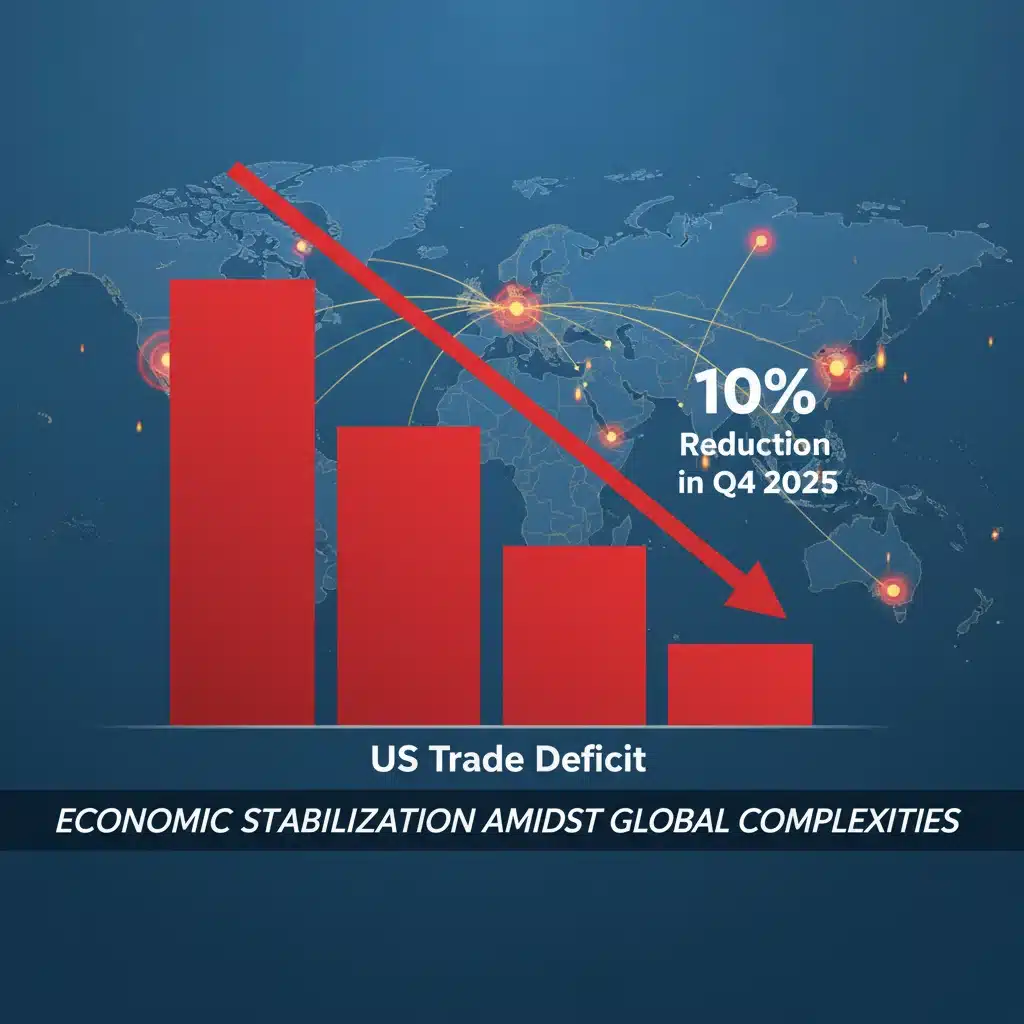
U.S. Trade Deficit Narrows by 10% in Q4 2025: Geopolitical Factors Influencing Global Economic Shifts
The global economic landscape is a perpetually shifting tapestry, woven with threads of trade, geopolitics, technological advancement, and societal change. In this intricate dance, the United States, as a dominant economic force, consistently finds itself at the center of attention. Recent data from the final quarter of 2025 has sent ripples of intrigue and optimism across financial markets and policy circles: the US Trade Deficit has narrowed by a significant 10%. This isn’t merely a statistical anomaly; it represents a profound shift with deep roots in evolving geopolitical dynamics and a testament to the adaptive capacity of global economic systems.
Understanding the implications of this reduction requires a deep dive into the multifarious factors at play. From shifting trade policies and the recalibration of international alliances to the ongoing impact of technological disruption and the imperative of supply chain resilience, every element contributes to the larger narrative. This article will meticulously dissect the reasons behind this notable contraction in the US Trade Deficit, explore the geopolitical undercurrents that shaped Q4 2025, and project the potential long-term ramifications for the global economy.
Anúncios
Understanding the U.S. Trade Deficit: A Primer
Before we delve into the specifics of the Q4 2025 reduction, it’s crucial to establish a foundational understanding of what the US Trade Deficit entails and why it matters. In essence, a trade deficit occurs when a country imports more goods and services than it exports. For the United States, this has been a persistent feature of its economic landscape for decades, often fueled by strong domestic consumer demand, a robust dollar, and the global appeal of its financial markets.
While a trade deficit is not inherently negative – it can, for instance, reflect a strong economy where consumers can afford to buy foreign goods, or it can be offset by capital inflows – a persistently large and growing deficit can signal underlying imbalances. These might include a lack of competitiveness in certain domestic industries, an over-reliance on foreign production, or even currency valuation issues. Conversely, a narrowing trade deficit typically suggests a few potential scenarios: increased domestic production, decreased consumer demand for imports, stronger export performance, or a combination of these factors.
Anúncios
The 10% reduction observed in Q4 2025 is particularly noteworthy because it signals a significant shift in these underlying dynamics, moving beyond typical cyclical fluctuations. This magnitude of change within a single quarter points towards structural adjustments and strategic policy decisions, heavily influenced by the geopolitical climate.
The Geopolitical Chessboard: Influencing Trade in Q4 2025
The global stage in 2025 was marked by a complex interplay of geopolitical forces. Several key developments directly contributed to the narrowing of the US Trade Deficit:
Shifting Trade Alliances and Realignments
The past few years have seen a concerted effort by many nations, including the U.S., to diversify trade partnerships and reduce over-reliance on single-source suppliers. In Q4 2025, this trend accelerated. New bilateral and multilateral trade agreements, particularly with emerging economies in Southeast Asia, Latin America, and parts of Africa, began to bear fruit. These agreements focused on reciprocal trade benefits, often including provisions for technology transfer and investment, which spurred both U.S. exports to these regions and diversified import sources away from traditional, often deficit-contributing, partners.
For instance, renewed focus on the Indo-Pacific Economic Framework for Prosperity (IPEF) and its practical implementation began to show tangible results, fostering closer economic ties and creating new markets for American goods and services, particularly in sectors like digital technology, clean energy, and advanced manufacturing. This strategic realignment aimed at both economic growth and geopolitical influence, effectively reshaping global supply chains.
Supply Chain Resilience and ‘Friendshoring’
The lessons learned from the supply chain disruptions of the early 2020s continued to resonate strongly in 2025. Companies, often encouraged by government incentives, prioritized resilience and security over sheer cost-efficiency. This led to a phenomenon often termed ‘friendshoring’ or ‘nearshoring,’ where production was moved closer to home or to politically aligned nations. This strategy significantly impacted the US Trade Deficit by reducing reliance on distant, potentially volatile, supply chains for critical components and finished goods.
Increased domestic manufacturing, particularly in semiconductors, pharmaceuticals, and certain industrial components, meant fewer imports in these crucial sectors. Furthermore, American companies began sourcing more inputs from neighboring countries like Canada and Mexico, leveraging established trade agreements and geographical proximity. This not only bolstered North American economic integration but also shortened delivery times and reduced logistical costs, making domestic and nearshore production more competitive.

Technological Sovereignty and Innovation
The race for technological supremacy continued unabated in 2025, with national governments investing heavily in strategic technologies. The U.S. saw a significant boost in its technological exports, especially in areas like Artificial Intelligence, quantum computing components, advanced biotechnology, and specialized software. These high-value exports contributed substantially to the narrowing of the US Trade Deficit, demonstrating America’s enduring innovative edge.
Moreover, policies aimed at fostering technological sovereignty led to increased domestic production of critical tech components, reducing import dependency. This push was not just about economic competitiveness but also about national security, ensuring that essential technological infrastructure was not solely reliant on foreign entities.
Energy Independence and Green Transition
The U.S. continued its trajectory towards greater energy independence, coupled with a robust push for renewable energy sources. While the global energy market remained dynamic, reduced reliance on imported fossil fuels, alongside increased exports of liquefied natural gas (LNG) to energy-hungry European and Asian markets, played a role. Furthermore, investment in green technologies, including solar panels, wind turbine components, and electric vehicle batteries, spurred domestic manufacturing and reduced the need for foreign imports in these rapidly growing sectors, thereby positively impacting the US Trade Deficit.
Economic Factors Driving the Reduction
Beyond the geopolitical machinations, several core economic factors underpinned the 10% narrowing of the US Trade Deficit in Q4 2025:
Stronger U.S. Export Performance
A resilient U.S. economy, coupled with targeted export promotion policies, led to a surge in American goods and services sold abroad. Key sectors driving this growth included:
- Advanced Manufacturing: U.S.-made machinery, aerospace components, and specialized industrial equipment saw increased demand in emerging markets and allied nations.
- Agricultural Products: Despite climate challenges, innovative farming techniques and strategic trade agreements ensured a consistent flow of American agricultural exports, particularly to Asian and African markets.
- Services Sector: The U.S. continued its dominance in services exports, including financial services, intellectual property, digital platforms, and educational services, which are often overlooked but contribute significantly to the overall trade balance.
Moderation in Import Growth
While exports surged, import growth moderated. This wasn’t necessarily due to a weakened domestic demand but rather a shift in its composition. Consumers, facing persistent but slightly easing inflationary pressures, became more discerning. Additionally, the aforementioned ‘friendshoring’ and domestic manufacturing initiatives meant that certain goods previously imported were now sourced domestically or from closer allies. The global supply chain reconfigurations also made some imported goods more expensive, leading to a natural reduction in demand or a shift to domestic alternatives.
Exchange Rate Dynamics
The U.S. dollar, while remaining a strong reserve currency, experienced some recalibration in Q4 2025. A slight softening against a basket of major currencies made American exports relatively more affordable for foreign buyers, thereby boosting demand. Conversely, it made imports marginally more expensive for U.S. consumers and businesses, contributing to the moderation of import growth. This subtle but impactful shift in exchange rates played a supportive role in the deficit reduction.
Investment in Domestic Capacity
Significant public and private investment in domestic infrastructure and manufacturing capacity, driven by legislative initiatives from previous years, began to yield tangible results. New factories came online, expanding production capabilities in critical sectors. This increased domestic output directly substituted for goods that would otherwise have been imported, providing a structural improvement to the US Trade Deficit.
The Broader Global Economic Shifts
The narrowing of the US Trade Deficit is not an isolated event but a symptom of larger, ongoing transformations in the global economy:
Reshaping Global Supply Chains
The era of hyper-globalization, characterized by highly optimized but fragile supply chains, is giving way to a more localized, diversified, and resilient model. Companies are building redundancies, diversifying suppliers, and bringing production closer to end markets. This trend, often driven by geopolitical uncertainty and national security concerns, is fundamentally altering global trade flows and will continue to impact the US Trade Deficit in the years to come.

Emergence of New Economic Powerhouses
While the U.S. remains a dominant force, the economic rise of other nations and regional blocs continues. The diversification of U.S. trade partners reflects a recognition of this evolving multi-polar economic world. As these new powerhouses grow, they offer both new markets for U.S. exports and alternative sources for imports, contributing to a more balanced global trade architecture.
The Digital Transformation of Trade
Digitalization is revolutionizing how goods and services are traded. E-commerce platforms, blockchain for supply chain transparency, and AI-driven logistics are streamlining international transactions. The U.S., being at the forefront of digital innovation, is uniquely positioned to leverage these advancements to enhance its export competitiveness and optimize its trade balance, further impacting the US Trade Deficit.
Climate Change and Green Trade
The imperative to address climate change is increasingly influencing trade patterns. Demand for green technologies, sustainable products, and carbon-neutral services is surging. The U.S.’s investment in its own green industrial base positions it as a key exporter in this rapidly expanding sector, while also reducing reliance on imported fossil fuels and environmentally intensive goods.
Potential Long-Term Implications
The 10% narrowing of the US Trade Deficit in Q4 2025 could herald several significant long-term implications:
- Enhanced Economic Stability: A more balanced trade position reduces external vulnerabilities and contributes to greater overall economic stability. It can lead to a more sustainable growth path, less susceptible to global shocks.
- Increased Domestic Employment: Greater domestic production and stronger export performance typically translate into more jobs in manufacturing, services, and related industries within the U.S.
- Reduced Geopolitical Leverage of Adversaries: By diversifying supply chains and strengthening trade alliances, the U.S. and its partners reduce the potential for economic coercion from geopolitical rivals.
- Shift in Global Economic Power Dynamics: A more balanced U.S. trade position, coupled with the rise of other economic centers, could lead to a more distributed global economic power structure, fostering a multipolar world order.
- Continued Innovation and Competitiveness: The focus on strategic industries and technological sovereignty is likely to spur further innovation within the U.S., maintaining its competitive edge in high-value sectors.
However, it is also important to consider potential challenges. A sustained reduction in the US Trade Deficit could, for instance, lead to a stronger dollar in the long run, potentially making exports more expensive unless productivity gains offset this. Furthermore, the complexities of managing new trade relationships and ensuring fair trade practices will remain paramount.
Conclusion: A New Chapter for U.S. Trade
The 10% narrowing of the US Trade Deficit in Q4 2025 is more than just a positive economic indicator; it is a reflection of a dynamic global environment where geopolitical considerations are increasingly intertwined with economic policy. This significant shift underscores a deliberate strategy of recalibrating trade relationships, bolstering domestic production, and investing in future-oriented technologies. The U.S. appears to be navigating a complex international landscape with an eye towards resilience, diversification, and strategic self-reliance.
As we move further into the mid-2020s, the trends observed in Q4 2025 will likely continue to evolve. Businesses, policymakers, and investors alike must remain attuned to these profound shifts. The future of global trade will undoubtedly be shaped by a continuous interplay of economic imperatives and geopolitical realities, with the U.S. Trade Deficit serving as a crucial barometer of these ongoing transformations. The journey towards a more balanced and resilient global economic system is underway, and Q4 2025 marks a significant milestone in this evolving narrative.