2026 Social Security COLA: What the 3.2% Increase Means for Your Retirement

Anúncios
Understanding the Latest 2026 Social Security Adjustments: What the 3.2% COLA Increase Means for Your Retirement Income
As we look ahead, one of the most significant financial updates for millions of Americans, particularly retirees and those planning for retirement, is the annual Social Security Cost-of-Living Adjustment (COLA). The projected Social Security COLA 2026 increase of 3.2% is a topic of considerable discussion and a critical factor in financial planning. This comprehensive guide aims to demystify the 2026 COLA, explaining what it is, how it’s calculated, and, most importantly, what this 3.2% increase could mean for your retirement income and overall financial well-being.
For many, Social Security benefits represent a vital, if not primary, source of income in retirement. Therefore, understanding the nuances of these adjustments is not just a matter of curiosity; it’s a fundamental aspect of sound financial management. The Social Security COLA 2026 is designed to help maintain the purchasing power of benefits, ensuring that retirees can keep pace with inflation. However, its actual impact can vary depending on individual circumstances.
Anúncios
What is the Social Security COLA?
The Cost-of-Living Adjustment (COLA) is an annual increase in Social Security and Supplemental Security Income (SSI) benefits paid to beneficiaries. It is designed to offset the effects of inflation, preventing the purchasing power of benefits from eroding over time. Without COLA, the fixed income of retirees would steadily lose value as the cost of goods and services rises. The Social Security Administration (SSA) announces the COLA each fall, with the changes taking effect in December and reflected in benefits paid starting the following January.
The legal basis for COLA stems from a 1975 law that mandated automatic annual adjustments. Before this, any increases in Social Security benefits required an act of Congress. The automatic COLA ensures that benefits keep pace with the economy without political intervention, providing a more stable and predictable income stream for beneficiaries.
How is the Social Security COLA 2026 Calculated?
The calculation of the Social Security COLA 2026, like all previous COLA adjustments, is tied to the Consumer Price Index for Urban Wage Earners and Clerical Workers (CPI-W). This specific index, published monthly by the Bureau of Labor Statistics (BLS), measures the average change over time in the prices paid by urban wage earners and clerical workers for a market basket of consumer goods and services.
Anúncios
Here’s a simplified breakdown of the calculation process:
- The SSA compares the average CPI-W for the third quarter (July, August, September) of the current year to the average CPI-W for the third quarter of the last year in which a COLA was enacted.
- If there is an increase, the percentage difference represents the COLA.
- For instance, to determine the Social Security COLA 2026, the SSA will compare the average CPI-W from Q3 2025 to Q3 2024. The projected 3.2% increase indicates economists’ expectations for inflation during that period.
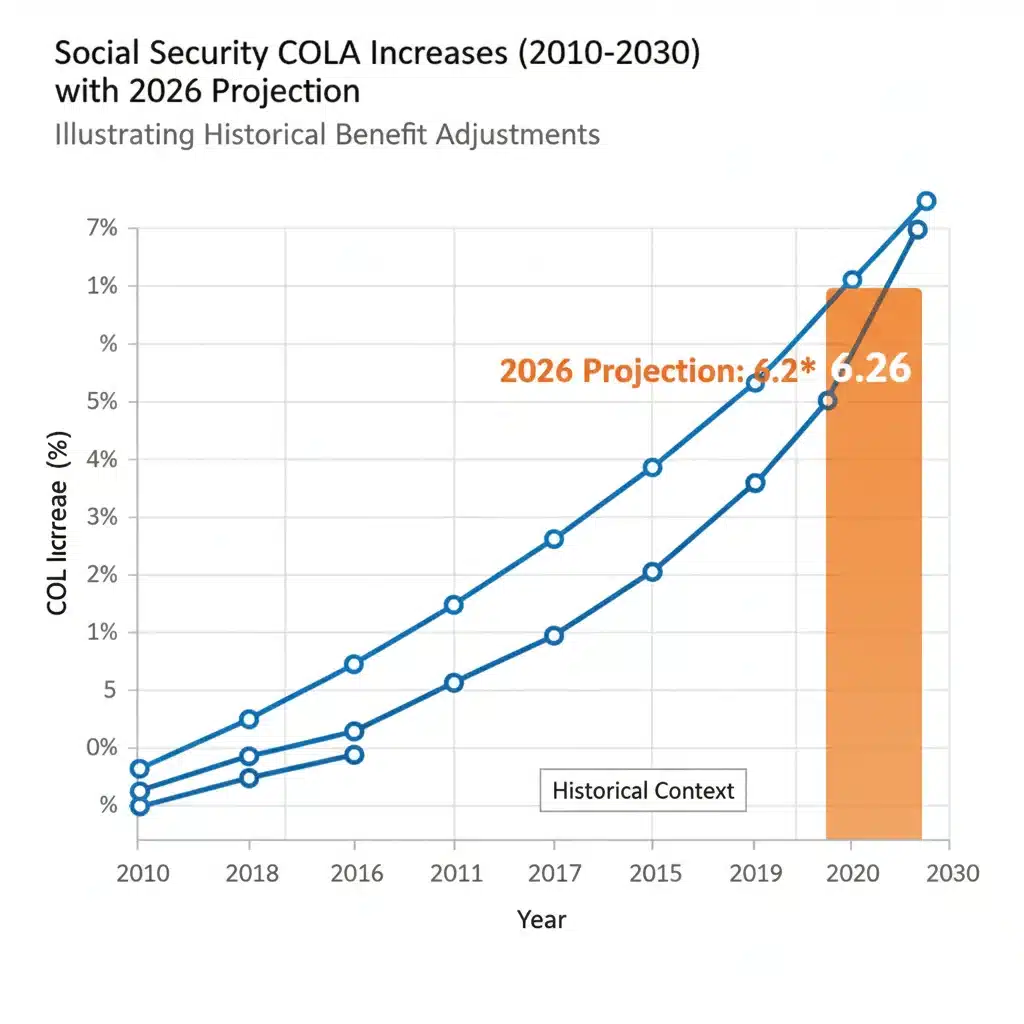
It’s important to note that if the CPI-W does not show an increase, there will be no COLA for that year. This has happened a few times in history, most recently in 2010, 2011, and 2016, when inflation was minimal or negative. However, the consistent upward trend in recent years suggests that a COLA is a near certainty for most years, including the projected Social Security COLA 2026.
The Projected 3.2% Increase for Social Security COLA 2026: What Does It Mean?
A 3.2% increase, while seemingly modest, can have a significant cumulative effect on your retirement income over time. For someone receiving an average Social Security benefit, this percentage translates into a tangible increase in their monthly payment. Let’s consider some hypothetical examples to illustrate the impact:
- If your current monthly benefit is $1,500, a 3.2% COLA would add $48 to your payment, bringing it to $1,548.
- For a higher earner receiving $2,500 per month, the increase would be $80, resulting in a new benefit of $2,580.
These increases are crucial for maintaining purchasing power, especially in an environment where the cost of living continues to rise. While 3.2% might not cover every single increase in personal expenses, it is designed to broadly align benefits with inflation, helping beneficiaries afford essential goods and services.
Impact on Different Beneficiary Groups
The Social Security COLA 2026 affects all Social Security beneficiaries, including:
- Retirees: The most numerous group, directly seeing an increase in their monthly retirement checks.
- Disabled Workers: Individuals receiving Social Security Disability Insurance (SSDI) will also experience a 3.2% increase in their benefits.
- Survivors: Spouses, children, and parents receiving survivor benefits will also see their payments adjusted upwards.
It’s a universal adjustment, ensuring that all those who depend on Social Security receive a proportionate increase to help counter inflation.
Beyond the Percentage: Real-World Implications of the Social Security COLA 2026
While the percentage increase is straightforward, its real-world implications can be complex. Several factors can influence how much of that 3.2% increase actually translates into more disposable income for beneficiaries.
Medicare Premiums and the ‘Hold Harmless’ Provision
One of the most significant factors that can offset a COLA increase is the cost of Medicare Part B premiums. These premiums are often deducted directly from Social Security benefits. Historically, when Medicare Part B premiums rise, a ‘hold harmless’ provision protects many beneficiaries from seeing a net reduction in their Social Security check. This provision ensures that the dollar amount of the Medicare Part B premium increase cannot exceed the dollar amount of their COLA increase.
However, the ‘hold harmless’ provision doesn’t apply to all beneficiaries, such as those who are new to Medicare, those who pay their Part B premiums directly, or those with higher incomes subject to income-related monthly adjustment amounts (IRMAA). For these individuals, a significant increase in Medicare premiums could potentially absorb a substantial portion, or even all, of their Social Security COLA 2026 increase.
Taxation of Social Security Benefits
Another often-overlooked aspect is the taxation of Social Security benefits. Depending on your ‘provisional income’ (which includes adjusted gross income, tax-exempt interest, and half of your Social Security benefits), a portion of your Social Security benefits may be subject to federal income tax. These thresholds are not indexed for inflation, meaning that as your benefits increase due to COLA, more of your income could become taxable over time, potentially pushing you into a higher tax bracket or making a larger percentage of your benefits taxable.
- Single Filers: If your provisional income is between $25,000 and $34,000, up to 50% of your benefits may be taxable. Above $34,000, up to 85% may be taxable.
- Married Filing Jointly: If your provisional income is between $32,000 and $44,000, up to 50% of your benefits may be taxable. Above $44,000, up to 85% may be taxable.
The Social Security COLA 2026, while beneficial, could incrementally increase your provisional income, potentially leading to a larger tax liability on your benefits. It’s crucial for beneficiaries to factor this into their financial planning.
Impact on Other Government Benefits
For some low-income beneficiaries, an increase in Social Security benefits due to COLA could affect their eligibility for other government assistance programs. Many programs have income thresholds, and even a modest increase in Social Security income could push an individual or household above these limits, potentially reducing or eliminating other vital benefits. This is a complex area, and individuals receiving multiple forms of assistance should consult with a financial advisor or relevant government agency to understand the full impact of the Social Security COLA 2026.
Strategies for Maximizing Your Retirement Income with COLA
Given the complexities surrounding COLA and its potential offsets, proactive financial planning is essential. Here are some strategies to help you maximize your retirement income and navigate the impact of the Social Security COLA 2026:
1. Understand Your Full Financial Picture
Don’t just look at your Social Security statement in isolation. Consider all sources of income (pensions, 401(k)s, IRAs, part-time work) and all expenses (housing, healthcare, food, transportation). A holistic view will help you understand the true impact of the 3.2% COLA increase on your overall budget.
2. Plan for Medicare Premium Increases
Anticipate potential increases in Medicare Part B and Part D premiums. If you’re not protected by the ‘hold harmless’ provision, these increases could eat into your COLA. Budget accordingly and explore options like Medicare Advantage plans or Medigap policies that might offer more predictable costs, though always weigh the trade-offs.
3. Consider the Tax Implications
If your provisional income is close to the taxation thresholds, even a small COLA increase could trigger higher taxes on your Social Security benefits. Work with a tax professional to understand your specific situation and explore strategies to manage your taxable income, such as Roth conversions or strategic withdrawals from retirement accounts.
4. Delaying Social Security Benefits (If Applicable)
For those not yet claiming Social Security, delaying benefits beyond your full retirement age (FRA) can significantly increase your monthly payment. For each year you delay up to age 70, your benefit increases by a certain percentage (8% per year for those born in 1943 or later). This delayed retirement credit, combined with future COLA increases, can lead to substantially higher lifetime benefits. The Social Security COLA 2026 will apply to your higher initial benefit amount, making the increase even more impactful.
5. Diversify Your Retirement Savings
Relying solely on Social Security for retirement income can be risky. Diversifying your retirement savings across various accounts (401(k)s, IRAs, taxable brokerage accounts) provides flexibility and reduces dependence on a single income source. This also allows you to draw income from different sources strategically to manage your provisional income and mitigate tax impacts.
The Future of Social Security and COLA
The sustainability of Social Security is a perennial topic of debate. While the Social Security COLA 2026 offers a positive adjustment for beneficiaries, long-term projections from the Social Security Trustees Report indicate that the program faces financial challenges in the coming decades. Without congressional action, the trust funds are projected to be able to pay only about 80% of promised benefits after a certain point.
Potential reforms could include:
- Adjusting the COLA Calculation: Some proposals suggest using a different inflation index, such as the Chained CPI, which typically grows slower than the CPI-W, potentially leading to smaller COLA increases.
- Raising the Full Retirement Age: Gradually increasing the age at which individuals can claim full benefits.
- Increasing the Social Security Tax Cap: Applying Social Security taxes to a higher amount of earnings, or even all earnings.
- Increasing the Social Security Tax Rate: A small increase in the percentage of earnings taxed for Social Security.
These discussions are ongoing, and any significant changes would require legislative action. For now, beneficiaries can rely on the current COLA mechanism, including the projected Social Security COLA 2026, to provide annual adjustments.

Conclusion: Navigating the Social Security COLA 2026 with Confidence
The projected 3.2% Social Security COLA 2026 represents a vital adjustment for millions of Americans, designed to help preserve the purchasing power of their retirement benefits. While it offers a welcome increase, understanding its broader implications – including potential impacts on Medicare premiums, taxation, and other benefits – is crucial for effective financial planning.
By staying informed, taking a holistic view of your finances, and planning proactively, you can navigate these adjustments with greater confidence. Whether you are already retired or planning for the future, the Social Security COLA 2026 serves as a reminder of the importance of understanding this foundational aspect of retirement income. Consult with financial advisors and tax professionals to tailor these general insights to your unique circumstances, ensuring your retirement journey remains secure and prosperous.